Showing posts with label Garden. Show all posts
Showing posts with label Garden. Show all posts
Coreopsis (and Company) in the Cottage Garden
 |
| Coreopsis 'Star Cluster' in bloom with companions Eucomis 'Sparkling Burgundy' (foliage left) echinacea (multiple varieties back) and purple phlox 'Nicky'. |
Three plants of Coreopsis 'Star Cluster' PPAF were added to my cottage garden in 2011. I was so impressed by the performance and beauty of this coreopsis, that I purchased five more plants this spring.
This 2010 introduction in the Big Bang ™ series is from Darrell Probst. For several years, I've happily grown his taller Coreopsis 'Red Shift' in the deer resistant meadow garden. 'Star Cluster' is shorter at 18-14 inches high and wide, making it more suitable for the scale of my cottage garden.
Refreshing Little Lime Hydrangea
 |
| First bloom of 'Little Lime' Hydrangea. June 28, 2012. |
What's the most refreshing bloom color on a 100°+ summer day? My vote goes to the huge, cool snowballs of 'Little Lime'™ hardy hydrangea from Proven Winners®.
I know! I know! I'm obsessed with refreshing lime and refreshed light green garden benches to cool down my garden!
Meadow Flowers Shine in Late Evening
 |
| The last rays of the sun shine on the willow at the end of lower path. There is order to the path edging plants, but there are"wild" flower pairings mixed in the rest of the deer resistant meadow garden. |
 |
| 1. Around 8:00 pm on a June evening in the deer resistant meadow garden. |
When the summer sun heats up and the temperatures rise, the best time to walk through the garden is late evening. The light is soft and the true colors are easier to capture with the camera.
1. The purple spikes of meadow blazing star (liatris ligulistylis) are backlit by gold/yellow black-eyed susans (rudbeckia hirta). White shasta daisies (leucanthemum x superbum 'Alaska') truly shine in the low light of the fading sun. Wisps of feather grass (stipa) provide a backdrop for the tufted blooms of deep raspberry bee balm (monarda 'Raspberry Wine').
Garden View from Street and Above
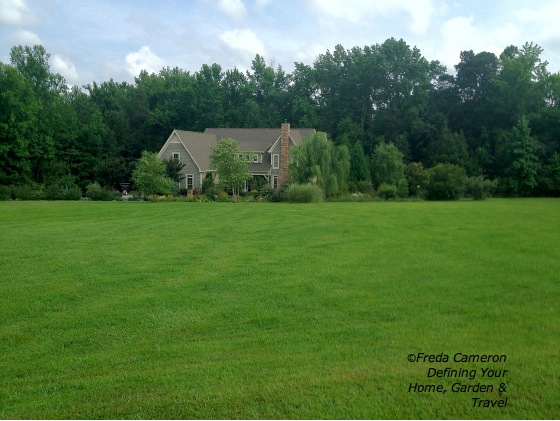 |
| Left of house is west and driveway with entry gravel garden. Right is east with the red/white and orange/yellow flowers. Front is south-facing with 2 acres of open meadow grass. There is no garden in the back (north) as our woods (2.5 acres) come up to the back deck. |
 |
| Paved driveway (west) ends in the gravel entry garden. |
The gravel entry garden is the first thing a visitor sees when arriving. There is sufficient space for a car to park in front of the bench. In a few years, the dwarf Burford 'nana' hollies will create a hedge to separate the gravel garden from our concrete parking area for our garage. A large oakleaf holly and a crepe myrtle flank the bench area. A row of rosemary lines the opposite side of the gravel parking space.
A Staggering Japanese Iris Vignette
 |
| Iris ensata. June 2012 |
Although I always dread the fall chore of digging up big clumps of Japanese iris every three years, I must admit that doing so opens the opportunity to try different vignettes.
The purple Japanese iris (tag long gone and so it is unknown) is a great bloomer. With my last division of this iris, I planted it graduated—or staggered—up a slope rather than on the same level. My logic was that each clump grows quickly and by planting each divided piece up the slope instead of grouped on the same level, I could hopefully extend the number of years before needing to divide again.
The Red and White Garden
 |
| OVERVIEW: Red and white garden, straight ahead, left. Orange and yellow garden on the near left by a new path cut-through. Green shrubbery (osmanthus fragrans and hollies) on the right. June 2012 |
The "red" in my "red and white garden" is delivered through monarda 'Jacob Cline' along with a mass planting of bright red salvia greggii, crocosmia 'Lucifer'. The red salvia blooms first, followed by the monarda, then the crocosmia.
The white daisies are planted uphill and for now, provide most of the "white" in this garden. Note: A yellow-blooming St. John's Wort shrub (left of the bench) provides the axis between the "red and white garden" and the "orange and yellow garden." The yellow centers of the daisies tie in with the yellow blooms of the shrub.
Blooms in the Gravel Garden
 |
| The hollies in the foreground will mature to create a hedge behind the bench. May 2012. |
Je ne regrette rien. I regret nothing. The conversion of several hardwood mulched garden beds and gravel parking space to one large gravel garden is working. Over one year later and I'm a very happy gardener. The history of the gravel garden can be viewed with this link.
Gravel gardens aren't for everyone. We don't live in the southwest or west coast where gravel is widely used. This is the southeast where folks love lush lawns, flower-packed or woodland gardens.
We live on a large rural property of over four acres with two acres of meadow grass out front while the back half is in woods. We have a sufficient proportion of soft grass, forest and gardens to balance the portion of gravel used.
Our house is English-inspired, but adapted for our climate. The same is true for the gravel garden. The inspiration comes from England, but it must work here in the southeastern United States. When using gravel, I had to use something locally quarried to be affordable. No expensive pea gravel here. Our house is gray cedar shakes. Our gravel is gray.
 |
| Looking through container lavender to a low hedge or rosemary. Purple Japanese iris grow from the gravel in the dry stream. Buddleia hedge in the gravel garden along the meadow edge. May 2012. |
 |
| Rosemary, Japanese iris, Buddleia are all thriving with gravel instead of hardwood mulch. May 2012. |
 |
| The gravel entry garden is easy to keep tidy and weed-free. View is looking away from the house to the driveway. May 2012. |
Yes there are a few weeds now and then. The roots have to reach a long way down to find soil. A gentle tug and wiggle easily removes unwanted weeds.
So far, I've not watered the shrubs, herbs or perennials that are planted in the gravel. The exception was to get the rosemary and hollies for the hedge established with one or two waterings around the time of planting. The buddleia, crepe myrtles, existing hollies, nepeta, salvia greggii and Japanese irises were already mature and have not been watered at all since we added the gravel in April 2011.
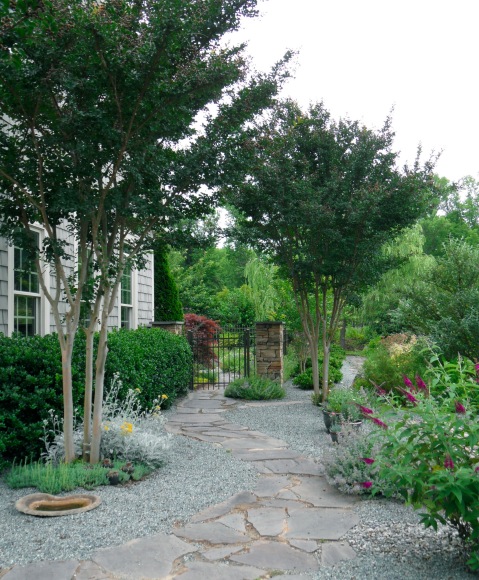 |
| View (from rosemary hedge) to cottage garden front gate. Existing hollies, sedum and dusty miller around crepe myrtle (left). Nepeta, patches of thyme (front & right) were existing. May 2012 Containers on right are barely visible (see next photo). |
 |
| April 2012, containers were added beside flagstone path. Euphorbia (front) container hasn't done well and will be replaced. Lavender (middle) is now in bloom. Salvia (large container) has been blooming non-stop. |
To keep the gravel from looking stark in some spots, I'm gradually adding containers of plants that are drought-tolerant. The salvia jamensis hybrid (large container) and lavenders (various containers), junipers and succulents are doing great.
We've been getting regular rainfall so far this year, so I've not had to water the containers. Even without rain, I've selected plants that don't need to be watered often and I'm enjoying the low-maintenance. All plants used in the gravel garden, whether planted in containers or in the ground, are deer resistant.
Perhaps one of the best rewards from changing to this gravel garden is that so much of my time has been freed up to focus on the deer resistant meadow garden and the cottage garden. (We also changed the mulched flagstone paths to gravel/flagstone paths along the deer resistant meadow garden in March 2012.)
Due to this gravel garden and path conversion, I've not been working in the garden full-time. This redesign has considerably downsized the work that I was doing when I tried to grow more plants in many beds along the driveway, parking area and sidewalk—not to mention all the weeding that I had to do in the mulched paths along the deer resistant garden!
Gardening has been much for fun for me in 2012. Je ne regrette rien.
 |
| Along the dry stream, a clump of existing monarda will soon bloom. The salvia greggii is also quite happy to mulched with gravel. May 2012. |
Blood Grass, Broadway Lights and a Bush
 |
| Spirea 'Magic Carpet' (back) Japanese blood grass 'Red Baron' (middle) Shasta 'Broadway Lights' (front). May 27, 2012. |
While rearranging the garden last fall, I was inspired to move, rather than give up on a Japanese blood grass (imperata cylindrica rubra var. koenigii 'Red Baron') that had been struggling during drought. By the end of summer 2010, the poor thing was looking rather sad and I wasn't sure if it could be saved. Surrounding it with plants to shade its roots seemed the best solution. The red color of the grass echoes the deep red of a spirea 'Magic Carpet' in my garden.
Please note: The species Japanese blood grass is on the noxious weed list of many states. In 2009, the reputation was so bad and the confusion so widespread that a local nursery couldn't sell blood grass. After a few months of waiting, I was allowed to purchase the better-behaving cultivar. If you are shopping for this grass, make sure you purchase imperata cylindrica rubra var. koenigii 'Red Baron'. It is suitable for zones 5-9.
Spirea 'Magic Carpet' has been moved more times than I can count! I think I've finally resolved my color issues with it. The spirea starts out quite orange tips in early spring, then the tip color turns to the deeper red-rust that I love. I have three of these shrubs in the deer resistant garden and there have been no issues with self-sowing. The blooms are a nice pink and I don't deadhead this spirea as I do another variety, 'Neon Flash' (also shown below).
 |
| Beyond the blood grass: Spirea 'Magic Carpet' (front) Stipa grass (middle) Spirea 'Neon Flash' (back). May 6, 2012. |
 |
| Leucanthemum 'Broadway Lights' ™ begins as a soft yellow and lightens to creamy white. Blue ageratum is allowed to roam around the path plants. May 27, 2012. |
My existing leucanthemum 'Broadway Lights'™ turned out to be a pretty good candidate to complete the combination with the spirea and blood grass. I've had this shasta for many years and use it to dot the path in the deer resistant meadow garden. A perennial for zones 5-11, deadheading is not required as the buttery flowers fade to white, but I like to neaten up the plants. The foliage remains evergreen in my zone7b garden.
I snapped today's photo when the first blooms of the shasta were open. Soon, the path in the deer resistant garden will once again be dotted with yellow daisies.
 |
| The leucanthemum clumps are just beginning to bloom along the path. Deer resistant meadow garden. May 27, 2012. |
Purple Milkweed Blooms Create a Buzz
 |
| Purple milkweed (asclepias purpurascens) attracts bees and other pollinators. A Monarch Butterfly host plant. May 2012 |
The first milkweed to bloom in my garden is ascelpias purpurascens, a native wildflower. Blooming and returning reliably this purple milkweed was purchased and planted four years ago. To date, there are only two seedlings that have volunteered nearby. Unlike common milkweed (ascelpias syriaca), this one isn't an agressive self-sowing perennial and I'd actually like to see more of this asclepias variety.
Being deer and rabbit resistant, the only issue I've had has been with the orange and black milkweed bugs eating the blooms. I pick those bugs off the flowers and send them packing.
The large globe blooms attract pollinators and the leaves are food for the caterpillars of the Monarch butterfly—though they seem to like the thin-leaved swamp milkweed (asclepias incarnata) when choosing plants in my garden for egg-laying. There have been times when I've had to move Monarch caterpillars from the swamp milkweed to the leaves of the purple milkweed! I tend to think this is because of the location of the milkweeds, with the swamp being among lush plants that serve as good places for the chrysalis and metamorphosis.
The veins in the long leaves of purple milkweed are a deep raspberry color like the large blooms. The sturdy stems are not weighed down by the blooms, standing straight in the garden, up to three feet in height and two feet in width. It is easy to tuck this one into a small space.
Hardy in zones 3-9, purple milkweed prefers a bit more moisture when planted in full sun (as in my garden). Though, in my garden, it is planted in a rather dry area, but the roots are shaded by neighboring perennials such as nepeta and agastache.
This is my favorite milkweed in terms of ornamental uses in the garden as well as being out of the ground in time for the early migrating Monarch butterflies.
Subscribe to:
Posts (Atom)
Popular Posts
-
 By Freda Cameron Although the weather has passed for planting, this is a great time to plan a garden with the children in your family. Durin...
 -
 George Washington's Mount Vernon is a reminder of the self-sufficiency of farms of historical significance. Did you know that Washingto...
 -
 Coreopsis ' Star Cluster ' in bloom with companions Eucomis 'Sparkling Burgundy' ( foliage left) echinacea (multiple...
 -
 The image of a table laden with a bountiful harvest isn't just for Thanksgiving. Local farmers' markets and Community Supported Agri...
 -
 There are few plants in the garden that are virtually maintenance-free. My favorite foliage plant is carex hachijoensis 'Evergold' ...
 -
 I tried to make a garden plan when I spread the soil in fall 2006 to create the outer gardens. I researched and researched the right plant...
 -
 Katie and the Giant Cabbage The idea for Katie’s Krops began with a 9 year old girl and a 40 pound cabbage. In 2008 Katie brought home a ti...
 -
 These "green" disfigured coneflowers were removed and destroyed. I didn't plant any new " green bloom " echinace...
 -
 May I see your identification please? Theft comes in many forms and recently garden bloggers have discovered that there are bad guys who wi...
 -
 By Freda Cameron What is the process of working with a professional garden designer? I asked this question at a local garden center that ha...