Showing posts with label garden design. Show all posts
Showing posts with label garden design. Show all posts
Garden Benches Refreshed
Many, many years ago at a property that I no longer own, a neighboring farmer teased me when I was painting my old, weathered barn. He said "A little bit of powder, a little bit of paint will make it look like what it ain't."
It was true that the old barn had warped boards and a rusty metal roof. It needed more help than a coat of paint. Fortunately, my metal garden benches were showing only a bit of rust and faded color—easily remedied by a good scrubbing and a coat of fresh paint. After seven years in the garden, I was ready to use some color.
I bought the spray paint, Valspar® Satin Leafy Rise, as my color of choice. It's a pale green that looks so much cooler than the dark bronze of the cottage garden bench or the black of the gravel garden bench. I also painted a rusty metal plant stand and a pot.
Meadow Flowers Shine in Late Evening
 |
| The last rays of the sun shine on the willow at the end of lower path. There is order to the path edging plants, but there are"wild" flower pairings mixed in the rest of the deer resistant meadow garden. |
 |
| 1. Around 8:00 pm on a June evening in the deer resistant meadow garden. |
When the summer sun heats up and the temperatures rise, the best time to walk through the garden is late evening. The light is soft and the true colors are easier to capture with the camera.
1. The purple spikes of meadow blazing star (liatris ligulistylis) are backlit by gold/yellow black-eyed susans (rudbeckia hirta). White shasta daisies (leucanthemum x superbum 'Alaska') truly shine in the low light of the fading sun. Wisps of feather grass (stipa) provide a backdrop for the tufted blooms of deep raspberry bee balm (monarda 'Raspberry Wine').
Garden View from Street and Above
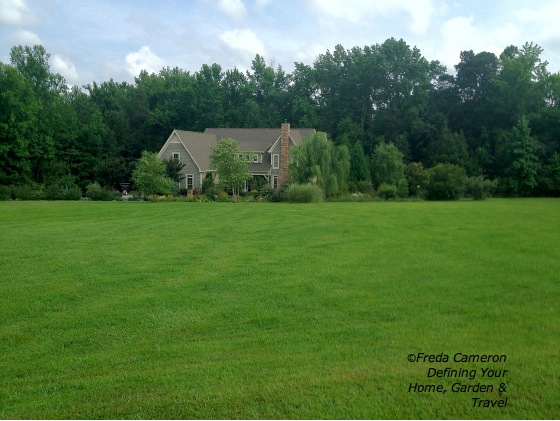 |
| Left of house is west and driveway with entry gravel garden. Right is east with the red/white and orange/yellow flowers. Front is south-facing with 2 acres of open meadow grass. There is no garden in the back (north) as our woods (2.5 acres) come up to the back deck. |
 |
| Paved driveway (west) ends in the gravel entry garden. |
The gravel entry garden is the first thing a visitor sees when arriving. There is sufficient space for a car to park in front of the bench. In a few years, the dwarf Burford 'nana' hollies will create a hedge to separate the gravel garden from our concrete parking area for our garage. A large oakleaf holly and a crepe myrtle flank the bench area. A row of rosemary lines the opposite side of the gravel parking space.
A Staggering Japanese Iris Vignette
 |
| Iris ensata. June 2012 |
Although I always dread the fall chore of digging up big clumps of Japanese iris every three years, I must admit that doing so opens the opportunity to try different vignettes.
The purple Japanese iris (tag long gone and so it is unknown) is a great bloomer. With my last division of this iris, I planted it graduated—or staggered—up a slope rather than on the same level. My logic was that each clump grows quickly and by planting each divided piece up the slope instead of grouped on the same level, I could hopefully extend the number of years before needing to divide again.
The Red and White Garden
 |
| OVERVIEW: Red and white garden, straight ahead, left. Orange and yellow garden on the near left by a new path cut-through. Green shrubbery (osmanthus fragrans and hollies) on the right. June 2012 |
The "red" in my "red and white garden" is delivered through monarda 'Jacob Cline' along with a mass planting of bright red salvia greggii, crocosmia 'Lucifer'. The red salvia blooms first, followed by the monarda, then the crocosmia.
The white daisies are planted uphill and for now, provide most of the "white" in this garden. Note: A yellow-blooming St. John's Wort shrub (left of the bench) provides the axis between the "red and white garden" and the "orange and yellow garden." The yellow centers of the daisies tie in with the yellow blooms of the shrub.
Blooms in the Gravel Garden
 |
| The hollies in the foreground will mature to create a hedge behind the bench. May 2012. |
Je ne regrette rien. I regret nothing. The conversion of several hardwood mulched garden beds and gravel parking space to one large gravel garden is working. Over one year later and I'm a very happy gardener. The history of the gravel garden can be viewed with this link.
Gravel gardens aren't for everyone. We don't live in the southwest or west coast where gravel is widely used. This is the southeast where folks love lush lawns, flower-packed or woodland gardens.
We live on a large rural property of over four acres with two acres of meadow grass out front while the back half is in woods. We have a sufficient proportion of soft grass, forest and gardens to balance the portion of gravel used.
Our house is English-inspired, but adapted for our climate. The same is true for the gravel garden. The inspiration comes from England, but it must work here in the southeastern United States. When using gravel, I had to use something locally quarried to be affordable. No expensive pea gravel here. Our house is gray cedar shakes. Our gravel is gray.
 |
| Looking through container lavender to a low hedge or rosemary. Purple Japanese iris grow from the gravel in the dry stream. Buddleia hedge in the gravel garden along the meadow edge. May 2012. |
 |
| Rosemary, Japanese iris, Buddleia are all thriving with gravel instead of hardwood mulch. May 2012. |
 |
| The gravel entry garden is easy to keep tidy and weed-free. View is looking away from the house to the driveway. May 2012. |
Yes there are a few weeds now and then. The roots have to reach a long way down to find soil. A gentle tug and wiggle easily removes unwanted weeds.
So far, I've not watered the shrubs, herbs or perennials that are planted in the gravel. The exception was to get the rosemary and hollies for the hedge established with one or two waterings around the time of planting. The buddleia, crepe myrtles, existing hollies, nepeta, salvia greggii and Japanese irises were already mature and have not been watered at all since we added the gravel in April 2011.
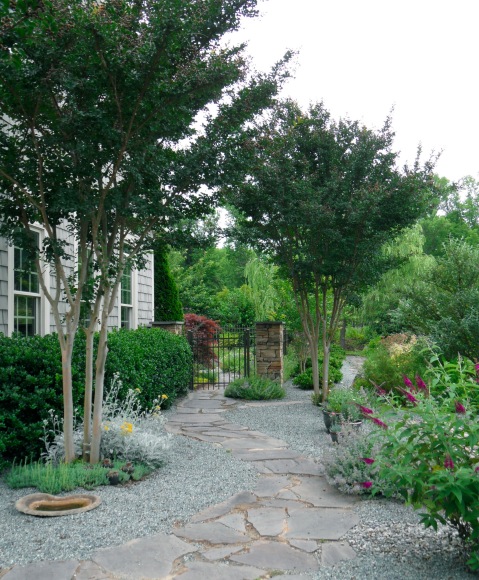 |
| View (from rosemary hedge) to cottage garden front gate. Existing hollies, sedum and dusty miller around crepe myrtle (left). Nepeta, patches of thyme (front & right) were existing. May 2012 Containers on right are barely visible (see next photo). |
 |
| April 2012, containers were added beside flagstone path. Euphorbia (front) container hasn't done well and will be replaced. Lavender (middle) is now in bloom. Salvia (large container) has been blooming non-stop. |
To keep the gravel from looking stark in some spots, I'm gradually adding containers of plants that are drought-tolerant. The salvia jamensis hybrid (large container) and lavenders (various containers), junipers and succulents are doing great.
We've been getting regular rainfall so far this year, so I've not had to water the containers. Even without rain, I've selected plants that don't need to be watered often and I'm enjoying the low-maintenance. All plants used in the gravel garden, whether planted in containers or in the ground, are deer resistant.
Perhaps one of the best rewards from changing to this gravel garden is that so much of my time has been freed up to focus on the deer resistant meadow garden and the cottage garden. (We also changed the mulched flagstone paths to gravel/flagstone paths along the deer resistant meadow garden in March 2012.)
Due to this gravel garden and path conversion, I've not been working in the garden full-time. This redesign has considerably downsized the work that I was doing when I tried to grow more plants in many beds along the driveway, parking area and sidewalk—not to mention all the weeding that I had to do in the mulched paths along the deer resistant garden!
Gardening has been much for fun for me in 2012. Je ne regrette rien.
 |
| Along the dry stream, a clump of existing monarda will soon bloom. The salvia greggii is also quite happy to mulched with gravel. May 2012. |
Garden Inspiration: White Garden Vignettes
 |
| 1. Jenny's White Garden at Fearrington Village. Pittsboro, North Carolina. March 2012 |
 |
| 2. Duke Gardens, Duke University. Durham, North Carolina. July 2011 |
 |
| 3. Duke Gardens. July 2011 |
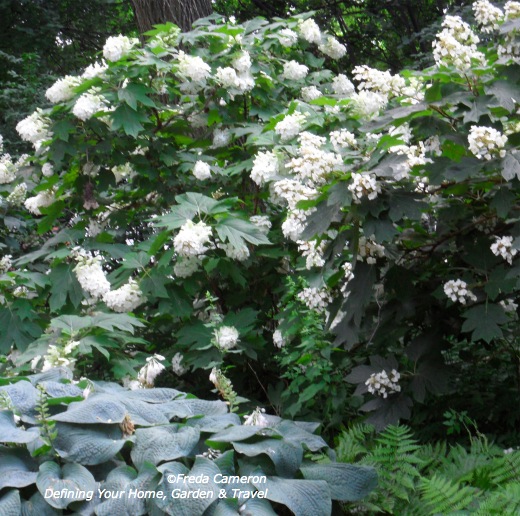 |
| 4. Central Park, New York City. June 2011 |
 |
| 5. Musée des Impressionismes, Giverny, France. May 2009. |
 |
| 6. In a Paris, France park. April 2011 |
- Jenny's White Garden at Fearrington Village changes with the seasons. Since this is located only five minutes from my home, I've seen the changes. In early spring, the white blooms are primarily daffodils and other spring bulbs.
- I've seen the Page-Rollins White Garden at Duke Gardens only in the heat of July where it was splendid in the 90+°F heat of the summer sun. There are succulents, perennials and annuals as well as foliage plants. I've not located a list of their plantings as this section of the garden is very new.
- The yucca container in the center was surrounded by sweet alyssum, a plant that I grow from seed that overwintered here in my zone7b garden during our mild winter of 2011.
- White hydrangeas and large, blue hostas provided a cool vignette in the shade on a hot June day in Central Park, New York City.
- For more information on the black and white flower garden, see my story about the Musée des Impressionismes in Giverny, France.
- Walking through a random park in Paris, France, I photographed these white tulips underplanted with white forget-me-nots.
For my own garden, I've started a small vignette using phlox 'David', Japanese iris 'Mount Fuji', sweet alyssum and snapdragon 'La Bella' white. A nandina 'Alba' is the only shrub. I've sown seeds for white moon vine to climb the fence behind this grouping. Outside the fence, three large oakleaf hollies provide the dark green backdrop. I'm looking forward to seeing the results.
I love fragrance and there are some white flowers that do not disappoint! The sweet alyssum smells like honey. Ginger, gardenia, jasmine and sweet bay magnolia are other fragrant plants in my garden.
With hot summers, the idea of enjoying the garden in evenings with cool temperatures is hugely appealing. White flowers can add sparkling magic to a garden in the evening. Added fragrance and good paths for meandering in the dark enhance the experience.
| Words and photos by Freda Cameron, Defining Your Home, Garden and Travel. All company or product or patented names mentioned are registered trademarks, copyrights, or patents owned by those respective companies or persons. |
The Gravel Garden Expansion
| We're rocking around the garden again! After the April 2011 gravel garden project proved to be such a success, we were shoveling and raking again on the first sunny days of a very early spring. I have to be more specific with the work credit—my husband did the heavy hauling and shoveling and I raked the gravel to smooth it into place. We did nothing to the last year's garden (photo below, click to enlarge) except raked it a bit and tugged out a few weeds that were easy to pull. All the shoveling and raking work of the last week was done to extend the use of gravel in the front entrance, upgrade the path through the deer resistant garden and create a Zen-inspired garden where a chaste tree was removed.
My husband is an enthusiastic supporter of gravel projects because he is in charge of mulching. Over the years, the application of hardwood mulch had to be repeated at least twice a year. That was a lot of work and expense. Voles love to tunnel under the hardwood mulch and they were slipping into the garden and devouring nearly every root they found. In Winter 2010, the vole damage was devastating! In Winter 2011, after we'd increased gravel mulch, the vole damage was ZERO! Of course, we still use hardwood and compost mulch in some garden spaces. The maintenance of the gravel garden has been easy and I certainly needed to downsize my work! We've not added gravel to last year's locations and the weeding was minimal. We use a wide plastic rake and a battery-operated blower to keep the gravel clean. The ground beneath the gravel stays relatively moist, making it easy to pull weeds (and flower seedlings). In fact, I easily wiggled out larkspur, poppy and nigella seedlings that were then transplanted into proper spaces in the garden beds. We mulch Japanese irises, monarda, nepeta, salvia greggii, perennial heliotrope, amsonia hubrichtii, rosemary, sedum, buddleia, crape myrtle and hollies with gravel. When I left the irises and monarda in place last year, I was sure that the perennials would bake and die since the gravel garden is in a southwest location. However, the opposite happened! I never once provided supplemental watering to any of the gravel garden plants during the summer drought. The gravel is permeable, allowing water to slowly seep into the soil. The gravel then reflects the sunlight, keeping the soil shaded and moist far better than hardwood mulch. The gravel makes it easy to walk in the garden year-round. It is especially nice on moonlit nights! The Cons of Using Gravel Not everyone likes the look and it's difficult to remove gravel once it is in place. While I'd love to use an expensive pea gravel for a prettier look, the cost is prohibitive, tripling the price of what we are using. The gravel that we use is $50 per CUBIC yard. You must keep the edges separated from grass. Grass will creep and crawl across the top of gravel, so using edging will help keep the grass at bay. We use a flexible metal edging (dark brown color) that is easy to drive into soil using the provided stakes and a rubber mallet. If you've got rock beneath your soil, it will be more difficult. You must have a way to keep the gravel from washing away during heavy rains. We have buried French drains around our entire garden perimeter, uphill from all of our gravel.
Entry Garden: We removed the unwanted plants and hardwood mulch on either side of the flagstone walk that leads to the cottage garden gate. In areas where we want in-ground plants, we do not use landscape fabric beneath the gravel. Sedum and dusty miller are at the base of a crape myrtle (on the left behind birdbath). I am going to use container gardens, placed on top of the gravel on the right side. Nepeta, crape myrtle, Japanese irises, amsonia and a clumping bamboo remain planted in the ground. Deer Resistant Garden Path: We set aside our existing flagstone while we worked. We hammered the flexible brown metal edging in the ground. The edging curves along the bottom of the deer resistant garden on the slope on the right side. On the left side, around the carrisa hollies and the crape myrtles, we replaced hardwood mulch with gravel to integrate with the new path. We raked the gravel into place and then placed our flagstones on top.
In that location, we had a large chaste tree that littered the ground with millions of seedlings each year. The seedlings were horrible to pull, requiring a shovel for the long roots. (We transplanted a few offspring out into our grassy meadow where they can no longer cause a problem in the garden.) Removing the large tree freed up my space for the Zen-inspired gravel garden. While it is still a work in progress (I want to add evergreen hollies behind the pagoda and find more large rocks for the edges), we're already enjoying this tranquil space. An existing clumping bamboo (fargesia variety) was left in place. Osmanthus fragrans provide a green, fragrant wall on the left side. Another osmanthus fragrans on the right side creates the entrance to the this garden after passing the willow tree and a garden space filled with red monarda 'Jacob Kline' and crocosmia 'Lucifer'. I must say that the fragrance from the osmanthus is heavenly right now! We moved our curved concrete bench to the space to provide a place to sit. The willow tree, large oakleaf hollies and osmanthus provide afternoon shade.
 Early spring is the perfect time for construction projects. While the edging looks stark right now, the plants will grow and flourish to soften the edges as the garden wakes up from winter, fills in, greens up and blooms. We have some tweaking to do as the gravel settles. We'll level out the flagstones and rake the gravel again after a few rains. Then, we'll enjoy the new space year-round. |


Lush Foliage with White Berries
 |
| Nandina domestica 'Alba' November 15 2011 |
This nandina, as with most plants that come to my garden, had to pass the deer resistant test in order to have a permanent location outside of my cottage garden fence. Unfortunately, deer eat nandinas. Don't let anyone convince you otherwise.
For at least four years, I have grown the 'Alba' outside my fence. Every winter the deer devoured the foliage. The deer will literally eat nandina down to stems and stubs. It's sad to see, but the shrubs do bounce back. The nandinas sprouted new foliage every spring and were fine in the summer. That said, they were never going to be fully enjoyed or allowed to mature with the yearly winter feast.
Over the last few months, I have moved all of my nandinas (I have one other variety, 'Gulf Steam') to locations inside my cottage garden for more enjoyment. I had to first remove a few other shrubs to make the space. The changeover has now been completed.
Nandina 'Alba' is a great evergreen shrub for zones 6-9 and can handle sun to part shade. Though it is drought tolerant, the nandina responds well to some pampering. I can't report on foliage color changes due to the deer dining, but in the summer, the leaves have a wonderful blue-green tint.
I love to underplant shrubs, so I am keep my 'Alba' nandinas trunk-pruned like small trees. Only two of my three nandinas survived the deer destruction.
I transplanted one to a small spot beside a stone fence corner and the gable gate to the cottage garden. The nandina replaced a phlox whose color had changed from purple to salmon pink. It is underplanted with ajuga repans 'Chocolate Chip' that holds up well in summer droughts and doesn't spread as enthusiastically as other varieties. This ajuga has dark leaves and blue blooms in spring. I chose to underplant the nandina with this ajuga (also moved from another part of the garden) because there are blue-blooming geranium 'Brookside' along this same path.
 |
| The poor little deer-devoured nandina (now beside the stone corner column) deserved to be protected. November 2011. |
 |
| Given another chance, the nandina is underplanted with ajuga repans 'Chocolate Chip'. November 2011. |
This nandina is planted beside the bridge to the stream. I added lots of good soil and compost and smoothed the area. With the large oakleaf hollies backing this area on the outside of the fence, I'm going with a white-flower theme.
An underplanting of seeds includes white snapdragon 'La Bella White' and my favorite sweet alyssum 'Carpet of Snow.' I usually plant snapdragons and alyssum in the spring, so this is a fall sowing experiment.
To the sides of this nandina, I sowed seeds of black peony poppy for spring drama, to be pulled out for summer when a division of phlox paniculata 'David' will bloom along with the alyssum. The snapdragons, phlox and alyssum are fragrant.
As gardeners, we show patience and optimism as we plan and create new garden areas and wait months or years for the results.
 |
| The new bed will include fragrant white phlox, sweet alyssum and snapdragons for 2012. November 2011. |
| Words and photos by Freda Cameron, Defining Your Home, Garden and Travel. Deer and rabbit resistance varies based upon the animal population and availability of food. All company or product or patented names mentioned are registered trademarks, copyrights, or patents owned by those respective companies or persons. |
September in the Cottage Garden
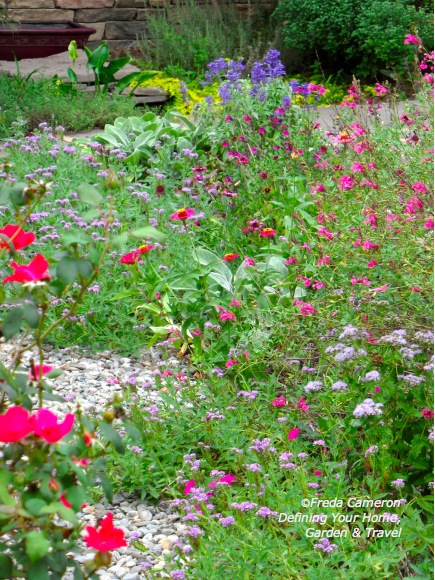 |
| Cottage garden rock path. Salvias, ageratum, perennial heliotrope, stachys, gaillardia, zinnias. |
The stellar performers are in the salvia family. Blue, white, red, purple and pink perennial salvias are packed with blooms. The hummingbirds are still here and grateful for the trumpets of salvia blooms.
The Knock Out® Roses have made a come back after the Japanese Beetle damage in June and July. I hate the beetle season and every time I see the stripped foliage of the roses I think I'll rip them out. Then, the roses bounce back and bloom and I keep them another year.
It has taken a few years for my sedum to mature without breaking over. A thick planting works best for sturdy stems. My favorite is 'Green Expectations' as shown in the photo with the blue salvia 'Victoria Blue'.
I rely upon creeping perennial heliotrope (heliotropium amplexicaule 'Azure Skies' in so many places throughout my gardens. It's a great edger that blooms non-stop from April until frost.
Annuals that bloom in early fall include alyssum, dianthus, verbena (bonariensis is fading, but imagination is non-stop), zinnias and rudbeckia.
With today's highs in the sixties, it is wonderful to have such a colorful cottage garden.
 |
| View across rock path to fence plantings. Sedum, salvias and roses. |
 |
| Sedum 'Green Expectations' is a favorite with dark stems. Salvia farinacea 'Victoria Blue' is the companion. |
 |
| Low-growing annuals include white alyssum 'Carpet of Snow', purple verbena 'Imagination' and bi-color dianthus. |
 |
| Cottage garden mix: alyssum, zinnias, susans, verbena, salvias. |
 |
| Every cottage garden needs zinnias! Benary's Giant in front. Candy Mix in background. |
 |
| Soft lambs ear provides big leaves and works with so many sun plants. Perennial heliotrope (heliotropium amplexicaule 'Azure Skies') back. |
| Words and photos by Freda Cameron, Defining Your Home, Garden and Travel. Deer and rabbit resistance varies based upon the animal population and availability of food. All company or product or patented names mentioned are registered trademarks, copyrights, or patents owned by those respective companies or persons. |
Creativity with Cottage Garden Annuals
 |
| Zinnia 'Candy Mix' with Rudbeckia hirta and Salvia farinacea 'Victoria Blue'. August 2011 |
Planting annuals is somewhat like playing with a box of crayons and cans of molding clay. I color the garden according to my latest taste in color schemes and shapes. I love the creativity and flexibility of changing the garden with annuals.
While I use annuals in my meadow gardens, it is the cottage garden where I have the most fun. Sitting on the front porch, I overlook the cottage garden and ponder many different ideas to try in the future. I get inspired and excited about what to grow next year!
 |
| A purple Persian Shield provides a dark background for the delicate and pale yellow California Poppies. May 2011 |
 |
| Same Persian Shield. Poppies replaced by a container (out of rabbit reach) of Gomphrena (and Million Bells in same purple, not seen). August 2011 |
 |
| Sweet Alyssum (white and fragrant) is the perfect annual edger and ground cover. August 2011 |
 |
| Tall lilac, pink, dark purple spires of larkspur back up the perennial daylilies and heliotrope. In the mix, there are also pods of annual blue nigella and blooms of bachelor's buttons. June 2011 |
Unfortunately, there was a casualty of recent rain storms. The huge castor bean "tree" planted against the stone chimney was beaten and broken. I ended up pulling the poor annual that had stood gloriously through the drought and high temps. Just as the red seed pods were ripening and beautiful, the plant, and all of the seeds are now gone. So easy to grow from seeds and such a great architectural annual, I'll reserve the chimney spot in 2012 for another castor bean. Next time, I'll put supports around the plant before the summer storms do their worst!
 |
| This 2011 castor bean was grown from the seeds of the 2010 plant...that was grown from seeds shared by Helen Yoest in 2009. July 2011 |
Grown from seeds sown in the fall:
- Larkspur
- Love-in-a-Mist (Nigella)
- Bachelor's buttons/cornflowers
- California poppies
- Peony poppies
- Salvia farinacea 'Victoria Blue' (annual/tender perennial)
- Verbena 'Imagination'
Seeds sown in spring for summer blooms:
- Rudbeckia hirta (big success and will try more varieties)
- Zinnia ('Bennary Giant' and 'Magellan' are truly wonderful)
- Alyssum (growing white, but want to try more colors)
- Hyacinth bean
- Castor Bean
- Marigold
Annuals that I purchase as small plants:
- Persian Shield
- Gomphrena (used only in a container due to rabbits)
- Million Bells (used only in container)
- Cleome
- Cosmos (rabbits eat young seedlings unless using the orange variety)
| Words and photos by Freda Cameron, Defining Your Home, Garden and Travel. Deer and rabbit resistance varies based upon the animal population and availability of food. All company or product or patented names mentioned are registered trademarks, copyrights, or patents owned by those respective companies or persons. |
A Funny Thing Happened in the Gravel Garden
 |
| Newly completed gravel garden. Only the row of small rosemary plants (left side opposite the bench) were added. Photo: April 28, 2011 |
What do I know about gravel gardens? Not mulch!
I don't live in desert areas where gravel gardens are used due to low rainfall. Desert areas in the United States grow the grasses and succulents—cacti, yucca and agave— that come to mind when I think of plants surrounded by gravel.
I don't live in the northern latitudes where gravel keeps plants from rotting in rain while warming up the area from the winter sun. Gardens in Europe use gravel around trees and shrubs and that was primarily where I drew my design inspiration, realizing that it is hot here in the summer with little rain.
My garden is in North Carolina, zone 7b and the idea of a gravel garden was a gamble that I was ready to take in April 2011. The project started as a problem solver as shown in the Before and After: From Driveway to Gravel Garden story. We were really looking more for a beautification solution to reduce maintenance, but have been surprised by the other advantages.
Here is a list of the plants that were left in place BEFORE we switched to gravel, removing all of the organic hardwood mulch:
Burford Nana (dwarf) Holly
Oakleaf Holly
Yucca
Buddleia (multiple varieties)
Crepe myrtle 'Tuscarora'
Osmanthus 'Goshiki'
Iris ensata (multiple varieties)
Monarda 'Blue Stocking'
Chamaecyparis pisifera 'Cream Ball'
Perennial heliotrope
We added a row of new rosemary and decided to take a "wait and see" attitude toward the existing plants. I watered the rosemary a few times to establish a root system.
 |
| The crepe myrtles bloomed and bloomed. The container plantings of lavender, juniper and succulents are thriving. Photo: July 12, 2011. |
Meanwhile, in the cottage garden and the rest of the outer, deer resistant gardens, I've been dragging water hoses and watering cans in an attempt to keep—even my drought-tolerant plants such as agastache, salvia and coneflowers—alive.
Back in the gravel garden, the foliage of the Japanese iris looks splendid and green. The monarda 'Blue Stocking' bloomed gorgeously. Those moisture-lovers didn't get any supplemental water from me. Tucked against buddleia, neither did those plants receive the full onslaught of the sun, but enough sun that made those same plants wither and wilt in the hardwood mulched areas of my garden.
Interesting. I was curious. No watering and virtually no weeds in the gravel garden for three months. No adding of more hardwood mulch to keep the soil moist.
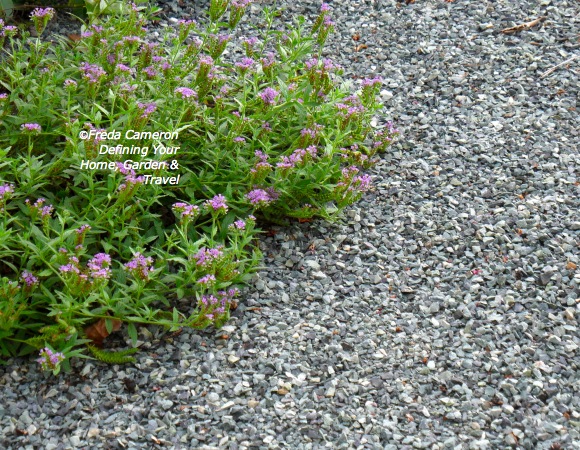 |
| Perennial heliotrope was literally covered in the gravel and emerged to make a happy ground cover around the Oak Leaf Holly. Photo: July 29, 2011. |
After a recent rainfall of one inch of rain, I dug a hole in the gravel garden; a hole in the deer resistant garden; and, a hole in the cottage garden.
Eleven inches down, the gravel garden soil was moist all the way—even though I had never watered it!
The other gardens had barely an inch of moist soil and ten inches of bone dry powder and I had been struggling to keep those areas watered. If anything, the cottage garden and other outer gardens have better soil than that beneath the gravel plantings.
Can it be that gravel, a permeable surface that allows rain to penetrate also prevents evaporation of moisture, even in day-after-day of 100°F temperatures?
My test is not scientific, but it is definitely making me think carefully about other areas that can handle gravel. Many of my drought-tolerant plants will be happy surrounded by gravel.
Gravel is not temporary! Once in place, especially two inches deep, it is difficult to remove. Therefore, I shall proceed with caution as I convert more areas to gravel to reduce the need for supplemental watering.
It's far too hot to take on a project like this during the summer. I want to also see the performance of the gravel garden plants over the winter as well as whether the weeds will pop up in the gravel. More waiting, but in the meantime, I can honestly say that the gravel garden is making us very happy.
 |
| The rosemary is flourishing. The foliage of the Japanese iris is green (without watering) and the butterfly bushes are happy and healthy. Photo: early morning, July 29, 2011. |
 |
| Guests do park here and the weeds have been so few. Photo: early morning, July 29, 2011. |
 |
| Merge of driveway with garden. Perennial heliotrope skirts the large holly. Photo: early morning, July 29, 2011. |
| Words and photos by Freda Cameron, Defining Your Home, Garden and Travel. Deer and rabbit resistance varies based upon the animal population and availability of food. All company or product or patented names mentioned are registered trademarks, copyrights, or patents owned by those respective companies or persons. |
Temporary Help Needed. Must Withstand Hot Summers.
 |
| Cleome is a tall summer annual for filling big spaces. |
| Temporary help is needed to fill in garden space during the heat of summer. The perfect candidate must be tall, colorful and play well with perennials. Additional skills required include deterring deer and rabbits while attracting hummingbirds, bees and butterflies. A big gap in my deer resistant garden needed a summer filler to add color and height among the foliage of the fall-blooming perennials. The annual, Cleome hassleriana, fit the job description—planted among Joe Pye Weed (native eupatorium purpureum), solidago 'Fireworks', helianthus angustifolius 'First Light', stipa (grass), asclepias incarnata and a tall pink mum. Without cleome, there would be nothing but foliage in the midsection of my front garden during the summer. In spring, rose campion and larkspur provide blooms for this space. When the temperatures rise and the rain is scarce, I can count on cleome to deliver! This is one annual that I don't grow from seeds because I am still developing the space. I buy the tall annual in bloom at a local greenhouse so that I can transplant directly into the summer garden where needed. I don't have a greenhouse to do this myself and I find the price affordable and worthwhile given how barren the garden would look without cleome. These are hybrids (I don't even bother to remember/save the name), so I've not had any self-sowing seedlings pop up.
In the above photo (click to enlarge), you cannot see the three Joe Pye growing between the cleome. The cleome not only provides height and color while waiting for the Joe Pye, it shades the roots of the companion plants, helping to retain moisture in this south-facing garden. I like a mass planting of at least five cleome. Without cleome, there would be a nothing but a low hole of foliage in my summer garden. Cleome bridges this gap from June until August, when the late summer flowers take over until frost. As for maintenance, I provide water only when the cleome leaves droop. There are no supporting stakes around the cleome, and while they are packed in among perennials, I've not noticed any need for support of these strong plants. Colorful, carefree and cheap. Deer, drought and rabbit resistant. I'll use cleome for temporary garden help every summer!
Words and photos by Freda Cameron, Defining Your Home, Garden and Travel. Deer and rabbit resistance varies based upon the animal population and availability of food. All company or product or patented names mentioned are registered trademarks, copyrights, or patents owned by those respective companies or persons. |


Subscribe to:
Posts (Atom)
Popular Posts
-
 By Freda Cameron Although the weather has passed for planting, this is a great time to plan a garden with the children in your family. Durin...
 -
 George Washington's Mount Vernon is a reminder of the self-sufficiency of farms of historical significance. Did you know that Washingto...
 -
 Coreopsis ' Star Cluster ' in bloom with companions Eucomis 'Sparkling Burgundy' ( foliage left) echinacea (multiple...
 -
 The image of a table laden with a bountiful harvest isn't just for Thanksgiving. Local farmers' markets and Community Supported Agri...
 -
 I tried to make a garden plan when I spread the soil in fall 2006 to create the outer gardens. I researched and researched the right plant...
 -
 There are few plants in the garden that are virtually maintenance-free. My favorite foliage plant is carex hachijoensis 'Evergold' ...
 -
 Katie and the Giant Cabbage The idea for Katie’s Krops began with a 9 year old girl and a 40 pound cabbage. In 2008 Katie brought home a ti...
 -
 These "green" disfigured coneflowers were removed and destroyed. I didn't plant any new " green bloom " echinace...
 -
 May I see your identification please? Theft comes in many forms and recently garden bloggers have discovered that there are bad guys who wi...
 -
 By Freda Cameron What is the process of working with a professional garden designer? I asked this question at a local garden center that ha...