Sedum Tips: All Grown Up and Blooming
 |
| Sedum 'Green Expectations' grown up. This was just a tip off the old plant in 2009. |
 |
| A tip taken from last year's tip! |
I actually use my pruners to make a clean cut, remove the bottom leaves and just stick the cuttings straight into garden soil.
The sedum performs best in drier soil and full sun, though they do well with afternoon shade. Choose companions that also work in the same conditions.
I grow sedum with salvia, perennial heliotrope, lavender, four o'clocks, agastache and purple heart.
The good news is that the rabbits leave the tall, blooming sedum alone, so I can grow these quite well inside the cottage garden fence. The bad news is that deer will probably eat the blooms, just when you are ready to enjoy the plant. Late summer and early fall is prime time for the deer to forage for food in flower gardens as the wild vegetation diminishes. Plants that deer ignore all summer may be more interesting in early autumn.
My 'Purple Emperor' sedum tips are doing well, but are not maturing as quickly as the 'Green Expecations'. I have blooms on only one of seven tips that I started in 2009. Sedum 'Bekka' has not done well in the summer humidity.
I would happily add more sedum varieties if I had the space! These are economical and carefree plants to fill a sunny garden.
 |
| Sedum 'Green Expectations' with deep pink Four O'Clocks and lavender-blue perennial heliotrope 'Azure Skies' |
 |
| Sedum 'Green Expectations' with salvia farinacea 'Victoria Blue' |
 |
| Sedum 'Purple Emperor' with gaillardia 'Grape Sensation' and foliage of cottage pinks (dianthus) |
| Words and photos by Freda Cameron, Defining Your Home, Garden and Travel. Deer and rabbit resistance varies based upon the animal population and availability of food. All company or product or patented names mentioned are registered trademarks, copyrights, or patents owned by those respective companies or persons. |
The Bush that Devoured the House
 |
| Lady Banks rose blooms yellow in spring. April 2010 |
All went well for four years. In the fifth year, the Lady Banksia Rose bush (a branching, not climbing rose) had shot up over thirty feet to the top of the gable and was trying to take over the upstairs window and chimney.
One would think a house safe from a non-climbing bush. Not so. The branches were undermining the cedar shakes on the house!
It had to go. The yellow blooms lasted only a few weeks each spring. Not much reward for the flowers, but I like the greenery branching over the top of the gable gate trellis.
My husband and I worked for a few hours to remove the bush. He started upstairs, reaching out the window to try to pull and cut branches that were under the eaves and latched onto the stone chimney. Our ladder doesn't reach those towering heights and a few remnants are still stuck on the house! Hopefully, they'll wither and die and not take root!
This is the second Lady Banks that we've removed in two years. Our landscaper planted one by the front garden gate and this one by the gable gate. Both were too damaging. Besides the cedar shake damage, the roots were pushing the stone corner columns and upsetting the fence and pathways as well.
I don't know if I'll plant another climbing perennial, but I want something to crawl over the top of the trellis above the garden gate in the summer months. Annual vines?
I need a vine that won't grow up under the cedar shakes, but will decorate the once-again bare trellis above the garden gate.
Clematis, but not the large Autumn Clematis, may be practical enough—perennial vines that are cut back each year, rather than evergreen that would climb and attach to the house once again.
Any ideas?
 |
| Lady Banks growing up over the window and reaching for the chimney. June 2010 |
 |
| Lady Banks gone and the trellis is bare. September 2010 |
| Words and photos by Freda Cameron, Defining Your Home, Garden and Travel. |
Variegated Obedient Plant
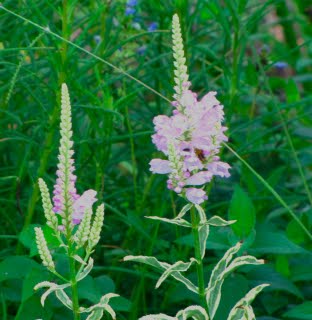 |
| Variegated obedient plant (physotegia virginiana) |
For three years, I have waited and waited for variegated obedient plant (physotegia virginiana) to create a mass planting. I have three blooms on one clump and one bloom on another clump; no blooms on a third clump.
The variegated foliage is much appreciated in the deer resistant garden, though the deer will definitely eat this plant if they are hungry enough. At least they allowed me the opportunity to see the beautiful blooms this year, which only makes me want more obedient plant!
According to my research, obedient plant can be grown in zones 2-9, which makes it sound very hardy. The seeds on this variegated variety are sterile, so it does not self-sow.
Last fall, I moved the plants to the part shade of butterfly bushes. That seems to have helped with the blooms, but it probably does well in full sun in cooler zones.
I've not had to stake the 36" high plants. They are narrow enough to fit in among my amsonia hubrichtii with perennial ageratum at the base. Good combinations as the amsonia foliage provides a lovely lush green backdrop until autumn, when it turns a brilliant gold. The buttons of lavender-blue ageratum bloom in late summer and blend well with these spires of lavender.
Do you grow any varieties of obedient plant? Is it behaving or misbehaving in your garden?

| Words and photos by Freda Cameron, Defining Your Home, Garden and Travel. Deer and rabbit resistance varies based upon the animal population and availability of food. All company or product or patented names mentioned are registered trademarks, copyrights, or patents owned by those respective companies or persons. |
A Japanese Garden; Can You Guess the Movie?
 |
| Japanese Garden Huntington Library, Art Gallery and Botanical Gardens Pasadena, California |
The Huntington Library, Art Gallery and Botanical Gardens is a great place to visit while in the Los Angeles area. Located in Pasadena, California, it is worth a day trip to explore the collections, indoors and out. In addition to the Japanese Garden, other themed gardens include: Australian, Camellia, Children's, Chinese, Desert, Herb, Rose, Shakespearean and the Rose Hills Foundation Conservatory for Botanical Science. If you are fan of bonsai, there is an impressive display!
The Japanese Garden is one of the most beautiful that I've ever seen and I was there in winter. I'm sure it is even more spectacular when the apricot, cherry, peach and plum trees are in bloom.
 |
| Japanese Garden January 10, 2010 |
| Words and photos by Freda Cameron, Defining Your Home, Garden and Travel. All company or product or patented names mentioned are registered trademarks, copyrights, or patents owned by those respective companies or persons. |
Subscribe to:
Posts (Atom)
Popular Posts
-
 By Freda Cameron Although the weather has passed for planting, this is a great time to plan a garden with the children in your family. Durin...
-
 George Washington's Mount Vernon is a reminder of the self-sufficiency of farms of historical significance. Did you know that Washingto...
-
 Coreopsis ' Star Cluster ' in bloom with companions Eucomis 'Sparkling Burgundy' ( foliage left) echinacea (multiple...
-
 The image of a table laden with a bountiful harvest isn't just for Thanksgiving. Local farmers' markets and Community Supported Agri...
-
 There are few plants in the garden that are virtually maintenance-free. My favorite foliage plant is carex hachijoensis 'Evergold' ...
-
 I tried to make a garden plan when I spread the soil in fall 2006 to create the outer gardens. I researched and researched the right plant...
-
 Katie and the Giant Cabbage The idea for Katie’s Krops began with a 9 year old girl and a 40 pound cabbage. In 2008 Katie brought home a ti...
-
 These "green" disfigured coneflowers were removed and destroyed. I didn't plant any new " green bloom " echinace...
-
 May I see your identification please? Theft comes in many forms and recently garden bloggers have discovered that there are bad guys who wi...
-
 By Freda Cameron What is the process of working with a professional garden designer? I asked this question at a local garden center that ha...