Showing posts with label Europe. Show all posts
Showing posts with label Europe. Show all posts
Free Palace in Paris
Is the line to visit the Louvre or Musée d'Orsay too long? Are the crowds at the Eiffel Tour overwhelming? Instead of paying and spending time waiting, there are free museums in Paris where you can walk right in and enjoy a bit of elbow space and quiet as you get up close to the exhibits.
Except for special exhibits and the archaeologic crypt and catacombs, there is no admission fee to see the permanent collections in the municipal museums in Paris. While residents of Paris are well aware of this benefit, most visitors are focused on the "must see" famous sites.
Le Petit Palais is a charming palace on a human scale. Located directly across Avenue Winston Churchill from Le Grand Palais, the smaller palace is filled with sculpture, paintings and relics. While you won't find the Mona Lisa, the galleries include representative examples over the ages: Paris 1900, Seventeenth-Nineteenth Centuries, Renaissance, Eastern and Western Christian, Ancient Greeks and Romans as well as Graphics, Photographic Collections, Books (including Oscar Wilde) and Manuscripts.
Le Petit Palais was built for the 1900 World's Fair. There are four wings to this trapezium structure that surround a central garden. The architecture and decoration make the Palais worth a short visit, even if you have no interest in the art collections. If you've been walking down the Avenue des Champs d'Élysées and are heading toward the Louvre or Invalides, the garden is a pleasant place to take a break.
There is a café for beverages and snacks, but with all the wonderful foods available in Paris, go somewhere else for a complete meal. The museum is closed on Monday and holidays, but it is open other days from 10:00 am until 6:00 pm, with last admittance at 5:00 pm.

Except for special exhibits and the archaeologic crypt and catacombs, there is no admission fee to see the permanent collections in the municipal museums in Paris. While residents of Paris are well aware of this benefit, most visitors are focused on the "must see" famous sites.
 |
| The courtyard garden inside Le Petit Palais. |
Le Petit Palais is a charming palace on a human scale. Located directly across Avenue Winston Churchill from Le Grand Palais, the smaller palace is filled with sculpture, paintings and relics. While you won't find the Mona Lisa, the galleries include representative examples over the ages: Paris 1900, Seventeenth-Nineteenth Centuries, Renaissance, Eastern and Western Christian, Ancient Greeks and Romans as well as Graphics, Photographic Collections, Books (including Oscar Wilde) and Manuscripts.
Le Petit Palais was built for the 1900 World's Fair. There are four wings to this trapezium structure that surround a central garden. The architecture and decoration make the Palais worth a short visit, even if you have no interest in the art collections. If you've been walking down the Avenue des Champs d'Élysées and are heading toward the Louvre or Invalides, the garden is a pleasant place to take a break.
There is a café for beverages and snacks, but with all the wonderful foods available in Paris, go somewhere else for a complete meal. The museum is closed on Monday and holidays, but it is open other days from 10:00 am until 6:00 pm, with last admittance at 5:00 pm.
 |
| In the garden. |
| Words and photos by Freda Cameron, Defining Your Home, Garden and Travel. All company or product or patented names mentioned are registered trademarks, copyrights, or patents owned by those respective companies or persons. |
Le Jardin Botanique de la Villa Thuret
The third time is a charm. Well, the garden is charming and on my third trip to Cap d'Antibes, I finally visited Le Jardin Botanique de la Villa Thuret. This is not a "oh my, look at all those colorful flowers" kind of place. This garden, created in 1857 by scientist Gustave Thuret, is a collection of exotic Mediterranean trees and shrubs. The garden will intrigue those with a keen interest in botany or offer tranquility to those simply looking for a lush place to stroll. There are "2500 individuals belonging to 1600 wild species and 145 botanical families." Every year, another 200 new species are introduced in this five acre garden. Newly-introduced plants are tested for their ability to adapt to the volcanic soil and local climate conditions. The new plants are watered for two years and only during extremely dry summers. Dead plant matter is left to drop and add humus to the soil. There's no mulching or mowing as wildflowers dot through clover and grass. Only the gravel paths are maintained to allow visitor access.
   
Being an American and accustomed to "staying on the path" I didn't venture into the grassy meadows to read the labels on the shrubs and flowers, such as peonies, agapanthus, clivia and crocosmia—nor all the plants that I can't identify! Given that we were the only visitors and everyone else had clipboards with eyes focused intensely on the plants, I had no clue as to the proper protocol. We weren't even sure if we were supposed to pay an admission fee. We walked into the open gates and saw no ticket stand. Since no one chased us down and demanded Euros, we assume that there was no charge. For a lovely, sunny day, a leisurely stroll through the gardens was worth the trip to Cap d'Antibes. To find Jardin Thuret from the town of Antibes, we headed west along the promenade at Ponteil. We crossed Boulevard James Wylie to follow Boulevard du Cap to Chemin Raymond. There is also an Enviro-bus that makes a circuit through the area for 1 Euro. The garden is closed on Saturday, Sunday and some holidays. Verify through the website. 
|


Garden Inspiration: Great Gates
After a long, leisurely and fabulous Saturday lunch at Plage Keller "Le Cesar" restaurant on La Garoupe Beach, my husband and I strolled along Boulevard Gardiole Bacon. This quiet street on the peninsula, Cap d'Antibes, is lined with villas—more accurately walled gardens that obscure the villas from view. Many of the villas are Provençal style, a common design in this area of France, and quite large and luxurious. Others are Spanish Mediterranean and then there are the modern architectural styles of white boxes. I prefer the traditional styles.
I love garden gates. Even the driveways have gates, and some of those are inspiring. Come along on a stroll down that boulevard as we walked back to Antibes, a distance of about four kilometers, depending upon how many detours we make to snap photos along the way. You see, we justify all the eating by walking!


I love garden gates. Even the driveways have gates, and some of those are inspiring. Come along on a stroll down that boulevard as we walked back to Antibes, a distance of about four kilometers, depending upon how many detours we make to snap photos along the way. You see, we justify all the eating by walking!
| Words and photos by Freda Cameron, Defining Your Home, Garden and Travel. All company or product or patented names mentioned are registered trademarks, copyrights, or patents owned by those respective companies or persons. |
Socca, A Niçoise Specialty
 |
| Socca being made and baked over a fire at the Marché Provençal, Antibes, France. March 2012. |
 |
| Freshly baked, piping hot socca is a Niçoise specialty made from chickpea flour and olive oil. |
Socca is a specialty of the area of France around the city of Nice on the Côte d'Azur. At the Marché Provençal in Antibes, we enjoyed a piping hot socca made over a fire. For only two Euros ($2.67), my husband and I shared the socca. Made from chickpea flour and olive oil, it has to be healthy, right? This was my first taste of socca as there are always long lines of customers waiting for these pancakes to come out of the oven. If you're interested in making socca at home, here's a recipe from David Lebovitz, an American pastry chef and cookbook author, who lives in Paris.
Words and photos by Freda Cameron, Defining Your Home, Garden and Travel. All company or product or patented names mentioned are registered trademarks, copyrights, or patents owned by those respective companies or persons. |

Garden Inspiration: White Garden Vignettes
 |
| 1. Jenny's White Garden at Fearrington Village. Pittsboro, North Carolina. March 2012 |
 |
| 2. Duke Gardens, Duke University. Durham, North Carolina. July 2011 |
 |
| 3. Duke Gardens. July 2011 |
 |
| 4. Central Park, New York City. June 2011 |
 |
| 5. Musée des Impressionismes, Giverny, France. May 2009. |
 |
| 6. In a Paris, France park. April 2011 |
- Jenny's White Garden at Fearrington Village changes with the seasons. Since this is located only five minutes from my home, I've seen the changes. In early spring, the white blooms are primarily daffodils and other spring bulbs.
- I've seen the Page-Rollins White Garden at Duke Gardens only in the heat of July where it was splendid in the 90+°F heat of the summer sun. There are succulents, perennials and annuals as well as foliage plants. I've not located a list of their plantings as this section of the garden is very new.
- The yucca container in the center was surrounded by sweet alyssum, a plant that I grow from seed that overwintered here in my zone7b garden during our mild winter of 2011.
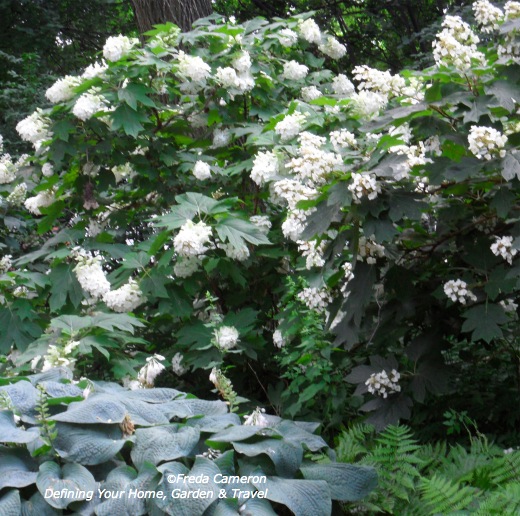
- White hydrangeas and large, blue hostas provided a cool vignette in the shade on a hot June day in Central Park, New York City.
- For more information on the black and white flower garden, see my story about the Musée des Impressionismes in Giverny, France.
- Walking through a random park in Paris, France, I photographed these white tulips underplanted with white forget-me-nots.
For my own garden, I've started a small vignette using phlox 'David', Japanese iris 'Mount Fuji', sweet alyssum and snapdragon 'La Bella' white. A nandina 'Alba' is the only shrub. I've sown seeds for white moon vine to climb the fence behind this grouping. Outside the fence, three large oakleaf hollies provide the dark green backdrop. I'm looking forward to seeing the results.
I love fragrance and there are some white flowers that do not disappoint! The sweet alyssum smells like honey. Ginger, gardenia, jasmine and sweet bay magnolia are other fragrant plants in my garden.
With hot summers, the idea of enjoying the garden in evenings with cool temperatures is hugely appealing. White flowers can add sparkling magic to a garden in the evening. Added fragrance and good paths for meandering in the dark enhance the experience.
| Words and photos by Freda Cameron, Defining Your Home, Garden and Travel. All company or product or patented names mentioned are registered trademarks, copyrights, or patents owned by those respective companies or persons. |
Garden Inspiration: FRANCiful Things I've Seen (Part Two)
 |
| Château Val Joanis winery and gardens. The white rock radiates warmth to the grape vines. Pertuis, France (Provence). April 2011. |
Fanciful and French—here are a few FRANCiful things I've seen.
Part Two. Provence.
We found Château Val Joanis with a little help from our friends on the SlowTravel France Forum, a car and a GPS. The winery is located between Pertuis and Villelaure, twenty-five kilometers north of Aix-en-Provence—our home base village during our April 2011 visit to Provence.
The château gardens are open from April through October and if you are on a driving tour, I recommend that you go a bit off the beaten path to stop by for an hour. The famous Mistral winds were kicking up during our visit on April 12, but as stated on the website, "...the terraced gardens are carved out of the slope and constructed in an area protected from the Mistral winds using stones salvaged from a Roman pool."
 |
| Table vignettes are strategically placed around the garden courtyard. (Click photos to enlarge.) |

The Val Joanis gardens are made up of three terraces. This is a productive garden, with veggies and fruits. Although laid to formal lines, there were touches of fun and whimsy though out the gardens. I was particularly intrigued by the copper post caps and the use of trellises in the gardens to add vertical height as well as provide support for climbing plants.
There is a mix of international influence in the garden. Rusty oriental-style lanterns hang on a parallel trellis across the garden from the copper post caps. There is even an interesting English-style wattle edging. Look closely at the photos to discover the material used instead of woven willow branches.
The garden was started in 1978 by the owner and a landscape architect. The vision was to create a 19th century garden. With paths, pergolas, parterres and arches, it's an inspiration on a smaller scale than many of the mammoth public gardens. Not overrun by tourists, this is a quiet little garden where a visitor can take time to study the plants and structures and watch the gardeners at work.
I've not mentioned the wine! This is a working vineyard and wine-tasting in the gift shop can be enjoyed either before or after your garden visit. The gift shop is also stocked full of interesting Provençal products.
 |
| My favorite whimsy—copper post caps. |

 |
| Take note of the "wattle" edging. Willow branches? No. |
 |
| Rebar is used to make the edging! |
 |
| Every garden needs a red birdhouse! |
 |
| Interesting alignment of vine-covered arches; one arch is within a woven pergola. |
 |
| Wisteria blooms on the long arbor that connects three terraces. The arbor is made from nineteenth century couloir à autruches. |
| Words and photos by Freda Cameron, Defining Your Home, Garden and Travel. Deer and rabbit resistance varies based upon the animal population and availability of food. All company or product or patented names mentioned are registered trademarks, copyrights, or patents owned by those respective companies or persons. |
Garden Inspiration: FRANCiful Things I've Seen (Part One)
Fanciful and French—here are a few FRANCiful things I've seen.
Part One. Paris.
I discovered a true fairytale garden shed in the Jardin des Plantes in Paris. "Shed" seems a rather shabby description of this round turret. The red French door with a lever handle is perfect.
An iron gazebo topping a hill in Le Jardin des Plantes reminded me of a wedding cake decoration. What cannot easily be captured in a photo is the spiral of hedges winding around that layered hill to reach the destination. Picnickers had already filled the gazebo to capacity on our sunny April day.
Of course, what gardener doesn't dream of a fabulous greenhouse? A pair of matching glass houses are literally filled with jungles of tropicals and other indoor plants. We can dream, can't we?

To visit Le Jardin des Plantes in Paris, I highly recommend jumping on a Batobus (boat) on the river Seine. Float through Paris and disembark at the stop for the Jardin des Plantes.
There are multiple street access points to the gardens: 57 rue Cuvier, 2 rue Buffon, 36 rue Geoffroy-Saint-Hilaire, place Valhubert 75005 Paris.
When to go? I have been the first week of April and the first week of May on warm, sunny days. Layering your clothes for Paris is always good idea. On a trip one June, it was cool enough for a jacket.

Please watch for the upcoming: Part Two. Provence.
Part One. Paris.
I discovered a true fairytale garden shed in the Jardin des Plantes in Paris. "Shed" seems a rather shabby description of this round turret. The red French door with a lever handle is perfect.
 |
| Jardin des Plantes; April 2011 in Paris, France. |
 |
| Parfait, qui? |
 |
| Intricate gazebo in the Jardin des Plantes. |
Of course, what gardener doesn't dream of a fabulous greenhouse? A pair of matching glass houses are literally filled with jungles of tropicals and other indoor plants. We can dream, can't we?

To visit Le Jardin des Plantes in Paris, I highly recommend jumping on a Batobus (boat) on the river Seine. Float through Paris and disembark at the stop for the Jardin des Plantes.
There are multiple street access points to the gardens: 57 rue Cuvier, 2 rue Buffon, 36 rue Geoffroy-Saint-Hilaire, place Valhubert 75005 Paris.
When to go? I have been the first week of April and the first week of May on warm, sunny days. Layering your clothes for Paris is always good idea. On a trip one June, it was cool enough for a jacket.
Please watch for the upcoming: Part Two. Provence.
| Words and photos by Freda Cameron, Defining Your Home, Garden and Travel. Deer and rabbit resistance varies based upon the animal population and availability of food. All company or product or patented names mentioned are registered trademarks, copyrights, or patents owned by those respective companies or persons. |
Garden Inspiration: Tulip Varieties in Paris
When gardening gets too hot, it's time to stay indoors and browse flower bulb catalogs. The catalogs begin appearing in my mailbox between July 4 and 14—coincidentally, America's Independence Day through France's Bastille Day.
Tulips are very popular in the spring gardens of Paris. The Jardin des Plantes, the Jardin des Tuileries and the Jardin du Luxembourg boast proud displays of tulips, often planted with forget-me-not, dusty miller, erigeron, wallflower or primula.
The group planting at Luxembourg is so inspirational, but there were no labels for me to identify the tulip varieties. The Jardin du Luxembourg (Luxembourg Gardens) and the Jardin des Tuileries are large parks, typically used for outings, strolling and enjoying the outdoors. The Jardin du Luxembourg, located in the sixth arrondissement, is the second largest park in Paris. The Jardin des Tuileries is easy to find as it is located between the Louvre Museum and Place de la Concorde.
At the Jardin des Plantes, a botanical garden in the fifth arrondissement of Paris, the plants are usually identified. The display is more for collectors who are interested in plant identification and genus. (Click any photo to enlarge.) If the color or shape inspires you, but you can't find the bulb, perhaps you can locate a similar substitute. Unless entering special exhibits or greenhouses, the botanical garden is free to the public. It is easily reached by taking a Batobus (or similar boat taxi) on the Seine and hopping off at the clearly marked Jardin des Plantes stop.


Most tulips may be grown in zones 3-8, but rely upon the information provided with the varieties you purchase. In warm zones, the tulips may not return due to the heat and many gardeners treat them as annuals. Grow tulips out of reach of marauding critters such as deer, squirrels, voles and rabbits. For me, that means containers only!
If you are interested in more photos of Jardin des Plantes, the Luxembourg Gardens or Monet's Gardens—many include vignettes of tulips—check out my page on Monet Gardens and Paris.
Tulips are very popular in the spring gardens of Paris. The Jardin des Plantes, the Jardin des Tuileries and the Jardin du Luxembourg boast proud displays of tulips, often planted with forget-me-not, dusty miller, erigeron, wallflower or primula.
 |
| Luxembourg Gardens, Paris France, April 2011: Tulip, primula, dusty miller, erigeron and forget-me-not. |
 |
| Tulips just beginning to bloom in April at the Tuileries, located between the Louvre and Place de la Concorde. |
At the Jardin des Plantes, a botanical garden in the fifth arrondissement of Paris, the plants are usually identified. The display is more for collectors who are interested in plant identification and genus. (Click any photo to enlarge.) If the color or shape inspires you, but you can't find the bulb, perhaps you can locate a similar substitute. Unless entering special exhibits or greenhouses, the botanical garden is free to the public. It is easily reached by taking a Batobus (or similar boat taxi) on the Seine and hopping off at the clearly marked Jardin des Plantes stop.


Most tulips may be grown in zones 3-8, but rely upon the information provided with the varieties you purchase. In warm zones, the tulips may not return due to the heat and many gardeners treat them as annuals. Grow tulips out of reach of marauding critters such as deer, squirrels, voles and rabbits. For me, that means containers only!
If you are interested in more photos of Jardin des Plantes, the Luxembourg Gardens or Monet's Gardens—many include vignettes of tulips—check out my page on Monet Gardens and Paris.
| Words and photos by Freda Cameron, Defining Your Home, Garden and Travel. All company or product or patented names mentioned are registered trademarks, copyrights, or patents owned by those respective companies or persons. |
Subscribe to:
Posts (Atom)
Popular Posts
-
 By Freda Cameron Although the weather has passed for planting, this is a great time to plan a garden with the children in your family. Durin...
 -
 George Washington's Mount Vernon is a reminder of the self-sufficiency of farms of historical significance. Did you know that Washingto...
 -
 Coreopsis ' Star Cluster ' in bloom with companions Eucomis 'Sparkling Burgundy' ( foliage left) echinacea (multiple...
 -
 The image of a table laden with a bountiful harvest isn't just for Thanksgiving. Local farmers' markets and Community Supported Agri...
 -
 There are few plants in the garden that are virtually maintenance-free. My favorite foliage plant is carex hachijoensis 'Evergold' ...
 -
 I tried to make a garden plan when I spread the soil in fall 2006 to create the outer gardens. I researched and researched the right plant...
 -
 Katie and the Giant Cabbage The idea for Katie’s Krops began with a 9 year old girl and a 40 pound cabbage. In 2008 Katie brought home a ti...
 -
 These "green" disfigured coneflowers were removed and destroyed. I didn't plant any new " green bloom " echinace...
 -
 May I see your identification please? Theft comes in many forms and recently garden bloggers have discovered that there are bad guys who wi...
 -
 By Freda Cameron What is the process of working with a professional garden designer? I asked this question at a local garden center that ha...