Showing posts with label flower bulbs and seeds. Show all posts
Showing posts with label flower bulbs and seeds. Show all posts
Native Wildflower Ratibida Columnifera Repels Deer?
 |
| Ratibida columnifera (Mexican hat, upright prairie coneflower, thimbleflower) with Santolina pinnata (green Lavender cotton) in the background. June 2012 |
Debuting in my deer resistant meadow garden this year is the US native wildflower, ratibida columnifera, commonly called Mexican hat. According to the Lady Bird Johnson Wildflower Center database, the foliage of this native has a strong smell that repels deer. But wait—there's a catch! The same database says that deer will eat this flower. Hmm...
Currently growing beside my open meadow where the deer congregate each night for slumber parties, there's nary a nibble so far. I've not detected an offensive smell—but I'm not a deer!
Frilly Bloomers
 |
| Peony poppy |
I don't grow peonies, but I grow peony poppies and that was my criteria when selecting this poppy. The full flowers fit the frilly flower formula. Peony poppies self-sow if you allow the seeds to ripen. Just shake the pods around and wait until next year. I'm still hoping my pale pink and nearly black (purple) ones will bloom. We had an incredibly warm winter and the poppy germination rate has (so far) been disappointing. Unlike me, poppies like a bit of a cold winter.
 |
| A mix of dianthus. |
 |
| Spirea, stipa, spirea—with a dash of blue nigella. |
 |
| Verbascum 'Southern Charm' |
 |
| Amsonia hubrichtii frilly foliage and flowers. |
 |
| Verbena 'Imagination' |
 |
| Itea 'Little Henry' |
While I never intentionally purchased frilly bloomers per se, each delivers a dose of delight in my garden.
| Words and photos by Freda Cameron, Defining Your Home, Garden and Travel. All company or product or patented names mentioned are registered trademarks, copyrights, or patents owned by those respective companies or persons. |
Cottage Garden Goes to the Gold
 |
| Coreopsis is surrounded by ground covers with near-twin blooms of light purple verbena 'Imagination' and heliotropium amplexicaule. |
 |
There is another possibility regarding the seeds. I sowed a packet of "mixed cottage garden" seeds that included annuals and perennials. Perhaps this coreopsis came from that mix instead? The hint at this possibility is that coreopsis is also growing among hesperis matronalis (Dame's Rocket) that must have come from the mixed packet—along with a barrage of susans (yet to bloom).
Before you all attack me with your gardening hoes, Dame's Rocket is not yet on the invasive list here in North Carolina. The plant is invasive in other states and countries. I'll have to manage it properly to prevent it from escaping the confines of the garden.
The coreopsis blooms have been going strong for at least three weeks, but I've not had to deadhead at this point. Yesterday's heavy rainfall beat the plant down a bit, but it is bouncing back and not drooping too much given the beating.
I've not seen any rabbit damage, but I've not seen any rabbits in the garden so far. There is a feral cat hanging around, not to mention a few black snakes and a hovering red-tailed hawk. This coreopsis is also growing out in the deer resistant garden and I have seen many deer. So far, so good.
I'll let the coreopsis grow as a test this year. If it performs well, I may just let it remain in the cottage garden. I have enough already, so I will deadhead the coreopsis and not let it go to seed.
As for the color gold—right now, I'm enjoying the glowing brightness among the purple blooms.
 |
| Coreopsis with Dame's Rocket (invasive in some areas). |
 |
| Coreopsis with purple larkspur (and buds of purple cornflower, not yet opened). |
 |
| The "back side" of the coreopsis as viewed from the porch after the rain. The "faces" of the coreopsis follow the sun, just like sunflowers. |
| Words and photos by Freda Cameron, Defining Your Home, Garden and Travel. Deer and rabbit resistance varies based upon the animal population and availability of food. All company or product or patented names mentioned are registered trademarks, copyrights, or patents owned by those respective companies or persons. |
Use Your 'Imagination' Verbena
 |
| Verbena tenuisecta 'Imagination' blooms spring, summer, fall until... |
Rated as an annual by most sources, every plant returned, making this verbena as hardy as any zone 7b perennial that I grow. It must take a seriously cold winter to kill it off. Thinking that 'Imagination' was a tender annual, I allowed it to self-sow.
Wait—there's more! I sowed seeds again in fall 2011. Maybe too many seeds! While it is lovely, meandering around tall plants and over short plants, it could easily takeover the garden. That said, it's easy to pull out. The color is a soft-purple, making it compatible with every color in my garden.
Don't worry about watering or babying this 'annual' as it is a tough plant for full sun to partial shade. Never drooping or complaining, it blooms continuously for three seasons. Deer, rabbits, voles and even a groundhog passed on this plant.
If you don't know what to plant as a meandering ground cover, just use this 'Imagination' verbena.
| Words and photos by Freda Cameron, Defining Your Home, Garden and Travel. Deer and rabbit resistance varies based upon the animal population and availability of food. All company or product or patented names mentioned are registered trademarks, copyrights, or patents owned by those respective companies or persons. |
Garden Inspiration: White Garden Vignettes
 |
| 1. Jenny's White Garden at Fearrington Village. Pittsboro, North Carolina. March 2012 |
 |
| 2. Duke Gardens, Duke University. Durham, North Carolina. July 2011 |
 |
| 3. Duke Gardens. July 2011 |
 |
| 4. Central Park, New York City. June 2011 |
 |
| 5. Musée des Impressionismes, Giverny, France. May 2009. |
 |
| 6. In a Paris, France park. April 2011 |
- Jenny's White Garden at Fearrington Village changes with the seasons. Since this is located only five minutes from my home, I've seen the changes. In early spring, the white blooms are primarily daffodils and other spring bulbs.
- I've seen the Page-Rollins White Garden at Duke Gardens only in the heat of July where it was splendid in the 90+°F heat of the summer sun. There are succulents, perennials and annuals as well as foliage plants. I've not located a list of their plantings as this section of the garden is very new.
- The yucca container in the center was surrounded by sweet alyssum, a plant that I grow from seed that overwintered here in my zone7b garden during our mild winter of 2011.
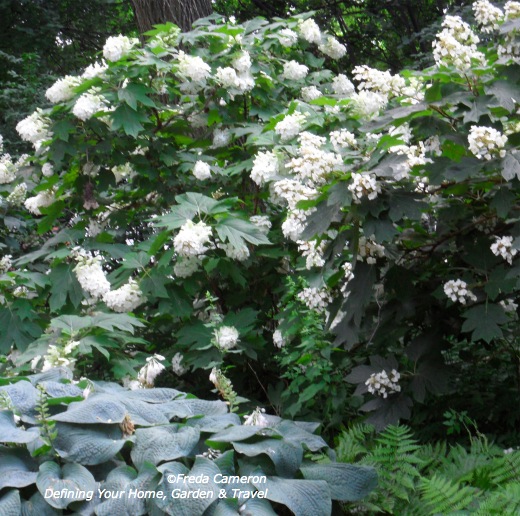
- White hydrangeas and large, blue hostas provided a cool vignette in the shade on a hot June day in Central Park, New York City.
- For more information on the black and white flower garden, see my story about the Musée des Impressionismes in Giverny, France.
- Walking through a random park in Paris, France, I photographed these white tulips underplanted with white forget-me-nots.
For my own garden, I've started a small vignette using phlox 'David', Japanese iris 'Mount Fuji', sweet alyssum and snapdragon 'La Bella' white. A nandina 'Alba' is the only shrub. I've sown seeds for white moon vine to climb the fence behind this grouping. Outside the fence, three large oakleaf hollies provide the dark green backdrop. I'm looking forward to seeing the results.
I love fragrance and there are some white flowers that do not disappoint! The sweet alyssum smells like honey. Ginger, gardenia, jasmine and sweet bay magnolia are other fragrant plants in my garden.
With hot summers, the idea of enjoying the garden in evenings with cool temperatures is hugely appealing. White flowers can add sparkling magic to a garden in the evening. Added fragrance and good paths for meandering in the dark enhance the experience.
| Words and photos by Freda Cameron, Defining Your Home, Garden and Travel. All company or product or patented names mentioned are registered trademarks, copyrights, or patents owned by those respective companies or persons. |
A Carpet of Snow in December
Drifts of snow white blanket the cottage garden in December. On a sunny winter day, the few remaining pollinators buzz among the blossoms. So far undaunted by frost, Sweet Alyssum 'Carpet of Snow' still flourishes.The honey fragrance of the blooms makes it nearly impossible to resist picking a stem to deeply inhale the scent. Braving the cold morning, I snapped a few photos of the alyssum, just before the sun warmed up the garden.
I sow seeds the tiny seeds of Sweet Alyssum (lobularia maritima) from October through March. Known as a cool climate annual, the small investment in seeds was worth the effort here in zone 7b of North Carolina.My cottage garden is a micro-climate more like zone 8a.
The alyssum patches spread remarkably wider in 2011 compared to 2010 and I believe this is due to some self-sowing. The height is relatively low, less than twelve inches. Beginning in April, the fresh and new alyssum sprouts bloom and they gradually spread over the next few months.
The focus of my mass plantings is an edge of the cottage garden path that is seldom seen until September. The heaviest blooms crank up from September until...we shall see!
During the hottest, scorching months, I grow taller annuals and perennials to shade the south side of alyssum. The blooms take a break on the hottest days, but the foliage is still lush until re-bloom. I've found the annual to be remarkably drought-tolerant and rabbit resistant. Given that the rabbits haven't touched the alyssum, I've sown seeds outside the fence in deer territory. I'm optimistic that the annual will be deer resistant.
I am so enamored by alyssum that I have already sown seeds in a new cottage garden bed that is based upon white with nandina 'Alba', phlox 'David' and a few other favorites.
Alyssum is the perfect plant for hiding the stems and ankles of taller plants. I've given thought to growing this versatile annual in so many spots! It is a wonderful companion for annual dianthus and verbena 'Imagination' as both are still blooming on this December morning.
With the low cost of seeds, the many months of blooms, fragrant scent and food for pollinators, Sweet Alyssum 'Carpet of Snow' has earned a permanent place in my garden.
 |
| Sweet Alyssum 'Carpet of Snow' (8:00 am, December 3, 2011) |
 |
| Alyssum with burgundy leaves of loropetalum. (December 3, 2011) |
The alyssum patches spread remarkably wider in 2011 compared to 2010 and I believe this is due to some self-sowing. The height is relatively low, less than twelve inches. Beginning in April, the fresh and new alyssum sprouts bloom and they gradually spread over the next few months.
The focus of my mass plantings is an edge of the cottage garden path that is seldom seen until September. The heaviest blooms crank up from September until...we shall see!
During the hottest, scorching months, I grow taller annuals and perennials to shade the south side of alyssum. The blooms take a break on the hottest days, but the foliage is still lush until re-bloom. I've found the annual to be remarkably drought-tolerant and rabbit resistant. Given that the rabbits haven't touched the alyssum, I've sown seeds outside the fence in deer territory. I'm optimistic that the annual will be deer resistant.
I am so enamored by alyssum that I have already sown seeds in a new cottage garden bed that is based upon white with nandina 'Alba', phlox 'David' and a few other favorites.
Alyssum is the perfect plant for hiding the stems and ankles of taller plants. I've given thought to growing this versatile annual in so many spots! It is a wonderful companion for annual dianthus and verbena 'Imagination' as both are still blooming on this December morning.
With the low cost of seeds, the many months of blooms, fragrant scent and food for pollinators, Sweet Alyssum 'Carpet of Snow' has earned a permanent place in my garden.
 |
| Annual dianthus, verbena 'Imagination' as companions. (September 2011) |
 |
| Alyssum and tender perennial/annual salvia 'Victoria'. (August 2011) |
 |
| Alyssum blooms are fewer and smaller in the heat of July. |
 |
| In the beginning. The first white blooms of Sweet Alyssum in May 2011. (Lower left hand corner) |
| Words and photos by Freda Cameron, Defining Your Home, Garden and Travel. Deer and rabbit resistance varies based upon the animal population and availability of food. All company or product or patented names mentioned are registered trademarks, copyrights, or patents owned by those respective companies or persons. |
Wild Quinine, A Native Plant

I'm wild about Wild Quinine (parthenium integrifolium) after seeing mass plantings at The Battery Gardens in New York in June 2011. In fact, I was so mesmerized by the tiny white pearl blooms that I failed to take one photo, but found a few on the gardens website!
I returned to do a bit of research and decided that this is a native wildflower to try in my meadow garden for 2012. Quinine is a perennial that blooms in summer. Seed heads can remain over the winter.
zones: 3a-8b
height: 36-38"
light: low to full sun
soil: medium
Finding the plants is not impossible, but I decided to try seeds for next year. According to the instructions on my seed packet, it is best to plant quinine in the fall or cold stratify for two to three months.
Fall sowing has always given me good results as our weather can often turn too hot, too soon in the spring. I'm not one to pamper pots, so I prefer to direct sow into the ground.
With the moisture from autumn rains and daytime temperatures forecast for 60-70° F for the next two weeks, I'm ready to sow! I have cleared a section of the garden for a mass planting of the quinine.
I will add a mix of organic soil, compost and conditioner to the area; rake it smooth; sow the seeds just below the soil line; walk across the area; water with a gentle spray to keep the soil moist.
The test in my garden will be to see whether or not quinine is deer and rabbit resistant and can tolerate the droughts here in zone 7b. I'm optimistic!
Quinine is an attractor for pollinators and food for chickadees, so I'm excited about the birds, bees and blooms for next year.
| Words and photos by Freda Cameron, Defining Your Home, Garden and Travel. Deer and rabbit resistance varies based upon the animal population and availability of food. All company or product or patented names mentioned are registered trademarks, copyrights, or patents owned by those respective companies or persons. |
Creativity with Cottage Garden Annuals
 |
| Zinnia 'Candy Mix' with Rudbeckia hirta and Salvia farinacea 'Victoria Blue'. August 2011 |
Planting annuals is somewhat like playing with a box of crayons and cans of molding clay. I color the garden according to my latest taste in color schemes and shapes. I love the creativity and flexibility of changing the garden with annuals.
While I use annuals in my meadow gardens, it is the cottage garden where I have the most fun. Sitting on the front porch, I overlook the cottage garden and ponder many different ideas to try in the future. I get inspired and excited about what to grow next year!
 |
| A purple Persian Shield provides a dark background for the delicate and pale yellow California Poppies. May 2011 |
 |
| Same Persian Shield. Poppies replaced by a container (out of rabbit reach) of Gomphrena (and Million Bells in same purple, not seen). August 2011 |
 |
| Sweet Alyssum (white and fragrant) is the perfect annual edger and ground cover. August 2011 |
 |
| Tall lilac, pink, dark purple spires of larkspur back up the perennial daylilies and heliotrope. In the mix, there are also pods of annual blue nigella and blooms of bachelor's buttons. June 2011 |
Unfortunately, there was a casualty of recent rain storms. The huge castor bean "tree" planted against the stone chimney was beaten and broken. I ended up pulling the poor annual that had stood gloriously through the drought and high temps. Just as the red seed pods were ripening and beautiful, the plant, and all of the seeds are now gone. So easy to grow from seeds and such a great architectural annual, I'll reserve the chimney spot in 2012 for another castor bean. Next time, I'll put supports around the plant before the summer storms do their worst!
 |
| This 2011 castor bean was grown from the seeds of the 2010 plant...that was grown from seeds shared by Helen Yoest in 2009. July 2011 |
Grown from seeds sown in the fall:
- Larkspur
- Love-in-a-Mist (Nigella)
- Bachelor's buttons/cornflowers
- California poppies
- Peony poppies
- Salvia farinacea 'Victoria Blue' (annual/tender perennial)
- Verbena 'Imagination'
Seeds sown in spring for summer blooms:
- Rudbeckia hirta (big success and will try more varieties)
- Zinnia ('Bennary Giant' and 'Magellan' are truly wonderful)
- Alyssum (growing white, but want to try more colors)
- Hyacinth bean
- Castor Bean
- Marigold
Annuals that I purchase as small plants:
- Persian Shield
- Gomphrena (used only in a container due to rabbits)
- Million Bells (used only in container)
- Cleome
- Cosmos (rabbits eat young seedlings unless using the orange variety)
| Words and photos by Freda Cameron, Defining Your Home, Garden and Travel. Deer and rabbit resistance varies based upon the animal population and availability of food. All company or product or patented names mentioned are registered trademarks, copyrights, or patents owned by those respective companies or persons. |
"Super Seeded" Blue Flax
Blue flowers for spring, pretty foliage through summer, repeat bloom in fall—easy to achieve by sowing the seeds of perennial blue flax. This self-sowing perennial is wonderful for dry, sunny gardens. A deer, rabbit and drought tolerant perennial that can be mixed with other perennials as well as annuals.
It is time to order seeds for fall sowing!
Flax is a perfect partner for the blooms of annual poppies, larkspur and cornflowers from April until June in my zone 7b garden. I sow seeds anytime between September through November for spring bloom. I have allowed some of the plants to self-sow and gathered seeds to plant in specific spots in the garden. In 2010, I planted some seeds in summer instead of waiting to the sow the seeds in fall. The foliage sprouted and was evergreen through winter, then bloomed the first time this spring.
If you try to collect seeds, it is a tedious task. Wait until the pods are brown and dry, then you must carefully pull the flat seeds out of the pod. I took the time for the task last year, but now I'm doing the "chop and drop" with the foliage and letting the seeds sow without my help.
To keep the foliage looking good through the summer, I cut the flax back by one third. Today, many of my flax plants that bloomed beautifully in spring are beginning to bloom again.
Throughout our days of 100° F and with no supplemental watering, all of my flax plants have survived and thrived. They never look wilted. This is truly a "hell strip" plant for xeric gardens.
I grow two varieties of blue flax and have mixed the two so much that I no longer pay attention to the minor differences. Linum narbonense 'Heavenly Blue' (zones 5-9) and linum perenne are both great performers, with the latter growing a bit taller and suitable for zones 4-9.
Flowers open in the morning and drop by noon during the bloom season. You'll have to take a morning garden walk with your camera to capture the beauties in bloom. I recommend sowing the seeds thickly and close together for a mass planting that is sure to please!
It is time to order seeds for fall sowing!
Flax is a perfect partner for the blooms of annual poppies, larkspur and cornflowers from April until June in my zone 7b garden. I sow seeds anytime between September through November for spring bloom. I have allowed some of the plants to self-sow and gathered seeds to plant in specific spots in the garden. In 2010, I planted some seeds in summer instead of waiting to the sow the seeds in fall. The foliage sprouted and was evergreen through winter, then bloomed the first time this spring.
If you try to collect seeds, it is a tedious task. Wait until the pods are brown and dry, then you must carefully pull the flat seeds out of the pod. I took the time for the task last year, but now I'm doing the "chop and drop" with the foliage and letting the seeds sow without my help.
 |
| Perennial blue flax blooms with annual California poppy in April 2011. Seeds for both were planted in autumn in zone 7b. |
Throughout our days of 100° F and with no supplemental watering, all of my flax plants have survived and thrived. They never look wilted. This is truly a "hell strip" plant for xeric gardens.
 |
| Perennials on parade in May 2011: Salvia 'May Night' (back) Linum perenne flax (middle) Agastache 'Cotton Candy' (front) |
I grow two varieties of blue flax and have mixed the two so much that I no longer pay attention to the minor differences. Linum narbonense 'Heavenly Blue' (zones 5-9) and linum perenne are both great performers, with the latter growing a bit taller and suitable for zones 4-9.
Flowers open in the morning and drop by noon during the bloom season. You'll have to take a morning garden walk with your camera to capture the beauties in bloom. I recommend sowing the seeds thickly and close together for a mass planting that is sure to please!
 |
| Blue flax with another salvia variety. |
| Words and photos by Freda Cameron, Defining Your Home, Garden and Travel. Deer and rabbit resistance varies based upon the animal population and availability of food. All company or product or patented names mentioned are registered trademarks, copyrights, or patents owned by those respective companies or persons. |
Garden Inspiration: Pow Wow Prairie Sun Evolution
 |
Back to Front: Echinacea purpurea 'Pow Wow Wild Berry' Salvia farinacea 'Evolution' Rudbeckia hirta 'Prairie Sun' (not quite) |
The echinacea, salvia and rudbeckia are all seed-grown plants. As such, the seeds may not always produce the plants to match the photo on the packets nor images you find in searching online. I am growing rudbeckia hirta 'Prairie Sun' with echinacea 'Pow Wow Wild Berry' and salvia farinacea 'Victoria (instead of 'Evolution' as shown in the photo).
Rudbeckia hirta 'Prairie Sun' (maybe)
perennial zones 5-10
full sun
In my case, my 'Prairie Sun' blooms look just like those in the inspiration photo above—brown-eyed susans. My seed packet showed a green eye, instead of a brown eye. If you've grown 'Prairie Sun' from seeds, did you get the green eye or the brown eye? I'd love to know.
At any rate, I still love these sunny plants, no matter what color the eyes! I cut these susans to bring indoors and the blooms last and last and last. These susans behave like annuals, such as zinnias. The more I cut, the more branching and blooms I get in the garden.
The deer have nibbled a few blooms out in the garden. However, the plants have continued to produce lots of blooms and the deer are now ignoring the new flowers, so I'm not unhappy with the deer tolerance test. I've not noticed the rabbits eating these susans (and they love to eat the rudbeckia fulgida 'Goldsturm').
This rudbeckia variety is definitely drought-tolerant. I've not seen any wilting in the heat and I'm rating these as preferable over the fulgida type. The susans in the most direct sun have reached three feet before I cut them back. The ones in part shade have remained under two feet. The Goldfinch love to eat the seeds and I do expect considerable self-sowing. That's okay with me!
 |
| Echinacea purpurea 'Pow Wow Wild Berry' |
Echinacea purpurea 'Pow Wow Wild Berry'
perennial zones 3-8
full sun
I'm still waiting for my echinacea 'Pow Wow Wild Berry' to bloom as they were grown from seeds in a local greenhouse. Unless sown early, coneflowers tend to bloom in the second season when starting from seeds. The leaves on this echinacea are huge and rough compared to other varieties that I've tried—'Prairie Splendor', 'Ruby Star', 'White Swan', 'Sundown' and others. The deer and rabbits haven't eaten the leaves so far. Not a tall coneflower, it should stay around two feet in height.
The 'Pow Wow Wild Berry' that I've seen in bloom are indeed impressive, so I have high hopes for similar blooms in 2012. My 'Prairie Splendor' in my cottage garden were under vole attack over the winter and I've been unable to find more plants, though I do have seedling replacements coming up for next year. I am hoping that 'Pow Wow Wild Berry' will be as wonderful as 'Prairie Splendor'.
Salvia farinacea 'Evolution'
perennial zones 9-11
The salvia in the inspiration is 'Evolution', a perennial in warm zones of 9-11. I am growing salvia farinacea 'Victoria' that overwintered for me here in zone 7b from 2010. I have 'Victoria' growing in multiply locations in my garden—out in the open garden on the east, south and southwest as well as protected in a warmer microclimate in my cottage garden. The blooms on 'Victoria' are heavy in early summer, then after deadheading, I'm waiting for the second flush. In 2010, the 'Victoria' looked great in late summer and fall.
The 'Victoria' have been reliably deer, rabbit and drought resistant in my garden. If the plant needs water, you'll know by the drooping leaves. The plant perks up quickly after watering.
Whether or not you select the same varieties, I do believe this inspiration can easily be replicated in color and form with similar plants.
| Words and photos by Freda Cameron, Defining Your Home, Garden and Travel. Deer and rabbit resistance varies based upon the animal population and availability of food. All company or product or patented names mentioned are registered trademarks, copyrights, or patents owned by those respective companies or persons. |
How to Collect Rose Campion (Lychnis coronaria) Seeds
Rose Campion (Lychnis coronaria) is a short-lived perennial for zones 3-9 but may behave like a biennial or an annual—depending upon your gardening zone. One way to make sure that you never run out of Rose Campion is to collect seeds or allow her to self-sow.
If you heavily mulch and compost your garden in autumn, then you are likely to cover over seeds that disperse naturally from the pods. I find Rose Campion seedlings growing next to the base of other plants, in gravel and in my dry stream, so it doesn't take much soil for the seeds to germinate. In other words, this is an easy plant to grow from seeds. My garden is filled with Rose Campion because I gently scrape up the shallow-rooted seedlings and transplant them to better locations in my garden.
I rely upon self-sowing and have never started the seeds indoors nor had to sow later in the fall, so here are planting instructions from three other sources (I have no affiliation):
Diane's Seeds
Johnny's Selected Seeds
Botanical Interests
Rose Campion is a wonderful and easy plant to grow. If you have too many, the extras are easy to remove from the garden. No pests, no deer, no rabbits, no voles have ever disturbed the Rose Campion in my garden. About the only thing that seems to damage the plant is too much water on the leaves. This is a drought-tolerant plant for full sun to part shade that requires little care other than cutting off the spent stems after the bloom.
It may take two years for your young seedlings to bloom, but the results are worth the wait!
If you heavily mulch and compost your garden in autumn, then you are likely to cover over seeds that disperse naturally from the pods. I find Rose Campion seedlings growing next to the base of other plants, in gravel and in my dry stream, so it doesn't take much soil for the seeds to germinate. In other words, this is an easy plant to grow from seeds. My garden is filled with Rose Campion because I gently scrape up the shallow-rooted seedlings and transplant them to better locations in my garden.
I rely upon self-sowing and have never started the seeds indoors nor had to sow later in the fall, so here are planting instructions from three other sources (I have no affiliation):
Diane's Seeds
Johnny's Selected Seeds
Botanical Interests
 |
| Rose Campion has long, silver stems. This variety has magenta blooms, but there are also white and pink/white colors available from suppliers. |
 |
| Seed pods are dry, shriveled and ready to harvest. To collect the seeds to save, cut off the pods and place them in a paper envelope. Cut the stems and discard. |
 |
| Cut the stems at the base, just above the rosette foliage. |
 |
| These cut stems, with pods, are discarded in the garden so that no seeds are released into the wild. Next spring, there will probably be seedlings around this bundle. |
 |
| Some seeds have already fallen out of the pods inside the envelope. These seeds have been drying for a week or two. |
 |
| I use a small Phillips screwdriver to easily open the pods. I hold the pod over the envelope to catch the seeds. You may want to wear thin plastic gloves when handling seeds as some varieties can irritate sensitive skin. Always wash your hands thoroughly after handling. |
 |
| With seeds emptied into the envelope, and pods discarded, pour the seeds into a small packet. (I had to hold the camera with one hand. I use two hands to do this!) |
 |
| I don't worry about a little of the chaff mixed in with the seeds. Commercial growers will remove the chaff. |
Rose Campion is a wonderful and easy plant to grow. If you have too many, the extras are easy to remove from the garden. No pests, no deer, no rabbits, no voles have ever disturbed the Rose Campion in my garden. About the only thing that seems to damage the plant is too much water on the leaves. This is a drought-tolerant plant for full sun to part shade that requires little care other than cutting off the spent stems after the bloom.
It may take two years for your young seedlings to bloom, but the results are worth the wait!
 |
| Rose Campion provides silver foliage and magenta blooms in the pink to purple color scheme of my deer resistant meadow garden. Companions include agastache, monarda, cleome, echinacea and liatris. |
| Words and photos by Freda Cameron, Defining Your Home, Garden and Travel. Deer and rabbit resistance varies based upon the animal population and availability of food. All company or product or patented names mentioned are registered trademarks, copyrights, or patents owned by those respective companies or persons. |
My "Lazy Gardener Garden" in Spring
 |
| Gaillardia 'Burgundy' self-sows; Achillea 'Moonshine' grows rapidly; Annual Nigella 'Miss Jekyll' self-sows. |
This large section of garden is on the east side of the house where the light has changed as trees have matured over the last five years. Rather than agonize over what to plant in a section where the sunlight and shade ratio is still changing, I'm allowing self-sowing and rapidly growing annuals, biennials and perennials "do their own thing."
I used to call this section the "butterfly garden" but since all of my different gardens attract butterflies, that's not as descriptive as it could be. I've relocated some of my stellar sun-loving perennials, such as coreopsis and agastache, from this section to the front garden.
There is a revolving color scheme of blue, purple, white, yellow, red and orange from spring through fall. All plants are drought tolerant and deer resistant, though there are a few plants, such as rudbeckia 'Goldsturm', that must be sprayed with rabbit repellent.
 |
| Salvia 'Caradonna' (self-sows true to parent), Homestead Purple verbena (spreads rapidly), and nepeta (easily divided) in April 2011. |
 |
| Purple salvia and nepeta give way to yellow, red and blue in late May. |
 |
| The prolific, self-sowing gaillardia can result in different colors and heights due to the cross-pollination of the varieties. |
salvia 'Caradonna' (self-sows true to parent)
allium 'Purple Sensation' (bulbs have multiplied over two years)
nepeta 'Six Hills Giant' (easily divided; minimal self-sowing)
'Homestead Purple' verbena (spreads rapidly by runners)
achillea 'Moonshine' (matures rapidly; divide every 3-4 years)
gaillardia (multiple varieties; some self-sow)
salvia greggii 'Navajo Red' (has produced offspring from seed that are true to parent)
salvia 'Black & Blue' (spreads by runners and easily divided in late spring)
salvia farcinacea 'Victoria Blue' (matures rapidly and am hoping for seedlings next year)
To bloom in summer:
monarda 'Jacob Cline' (spreads rapidly by runners; needs more moisture than the other plants)
ageratum 'Wayside Blue' (self-sows and spreads rapidly by runners)
crocosmia 'Lucifer' (corms grow rapidly and can be easily divided)
achillea 'Terracotta' (matures rapidly; divided every 3 years)
shasta daisies (divides easily; some varieties self-sow)
rudbeckia 'Goldsturm' (self-sows)
laceflower (self-sows)
marigolds (some varieties self-sow)
orange cosmos sulphureus (self-sows)
echinacea 'Sundown' (hasn't performed well for five years)
agastache (some varieties self-sow)
asclepias tuberosa (self-sows)
ascleplias incarnata (self-sows, but takes years to bloom; more moisture)
hypericum 'Sun Pat' is shrub-like (minimal self-sowing)
amsonia hubrichtii (self-sows)
verbena bonariensis (self-sows)
Russian sage (self-sows, but is new to the garden)
bronze fennel (self-sows too much; must deadhead)
Because I allow the plants to self-sow and spread, there is minimal care and maintenance. I let the seed heads stand until the following spring, when I cut them back at one time, divide any mature plants and transplant seedlings. I rarely provide supplemental water unless rainfall is scarce when the transplants and seeds need a good start. Since I allow the self-sowing of seeds, I don't use mulch except around the base of new plants. Mulch on top of the ripened and fallen seeds would prevent germination. In spots where the soil needs boosting, I work in amendments (organic compost) and sow seeds of filler plants such as nigella for spring and marigolds and cosmos for summer.
Less maintenance for the gardener means more time to enjoy the flowers (and work on the other gardens)!
| Words and photos by Freda Cameron, Defining Your Home, Garden and Travel. Deer and rabbit resistance varies based upon the animal population and availability of food. All company or product or patented names mentioned are registered trademarks, copyrights, or patents owned by those respective companies or persons. |
Subscribe to:
Posts (Atom)
Popular Posts
-
 By Freda Cameron Although the weather has passed for planting, this is a great time to plan a garden with the children in your family. Durin...
 -
 George Washington's Mount Vernon is a reminder of the self-sufficiency of farms of historical significance. Did you know that Washingto...
 -
 Coreopsis ' Star Cluster ' in bloom with companions Eucomis 'Sparkling Burgundy' ( foliage left) echinacea (multiple...
 -
 The image of a table laden with a bountiful harvest isn't just for Thanksgiving. Local farmers' markets and Community Supported Agri...
 -
 There are few plants in the garden that are virtually maintenance-free. My favorite foliage plant is carex hachijoensis 'Evergold' ...
 -
 I tried to make a garden plan when I spread the soil in fall 2006 to create the outer gardens. I researched and researched the right plant...
 -
 Katie and the Giant Cabbage The idea for Katie’s Krops began with a 9 year old girl and a 40 pound cabbage. In 2008 Katie brought home a ti...
 -
 These "green" disfigured coneflowers were removed and destroyed. I didn't plant any new " green bloom " echinace...
 -
 May I see your identification please? Theft comes in many forms and recently garden bloggers have discovered that there are bad guys who wi...
 -
 By Freda Cameron What is the process of working with a professional garden designer? I asked this question at a local garden center that ha...