Drought-tolerant Plants without Spring Rain
 |
With every year, I try to take note of these weather swings to cull out plants that can't handle it. My garden is too large to deal with plants that require too much attention to thrive. I moisten the soil for the seeds that I've sown this spring and hand-water newly planted perennials. Otherwise, the plants must be water-wise.
That said, the garden looks pretty good. Most of my dividing and rearranging was done in the fall, giving the roots time to establish over the wet winter. Since I don't have drip irrigation in 95 per cent of the outer gardens, the selected plants are drought tolerant.
 |
 |
Trees and shrubs—such as buddleia, crepe myrtle, hollies and vitex—are going without water.
Annuals—sown from seeds last year—are handling the drought well, too. Cornflowers, larkspur, nigella, poppies and rose campion are blooming and full of buds.
Of course, rain is desperately needed. The soil is far too dry. Although I'm not yet seeing the signs of drooping leaves, the plants cannot continue forever without water. We can only hope for rain. Thank goodness for the drought-tolerant plants that are holding up the garden.
| Words and photos by Freda Cameron, Defining Your Home, Garden and Travel. All company or product or patented names mentioned are registered trademarks/copyrights/patents owned by those respective companies or persons. |
Bloom Time Line: Spring Bulbs
When do plants bloom? That's always an important question when designing a garden. By noting bloom times, it is easier to match up companions for the future.
When selecting bulbs to bloom in mid-April, I shopped for bloom times in May or June—based on zone 5 bulb sellers.
All of my bulbs were planted in late autumn for spring bloom. The bulbs that have been in my garden for several years bloomed a few days earlier than new bulbs. Bloom time was also earlier for bulbs in all day full sun— versus bulbs in sun for half of the day.
Below is a recap of the dates for spring blooming bulbs in my zone 7b garden in North Carolina. Of course, warmer zones will have earlier blooms and cooler zones will have later blooms. Bloom times also differ by variety, so I'm not including daffodils in my recap.
April 15 - Dutch iris (iris x hollandica)
Blooms finished on most varieties by May 7.

April 15 - Spanish bluebells (Hyacinthoides hispanica)
Blooms ended around April 30.

April 15 - allium aflatunenense 'Purple Sensation'
Blooms were fading by May 7, but the green orbs will be interesting for another week.

April 22 - Star of Persia (allium christophii)
Still in bloom on May 7 and the green orbs will be left for interest.

Every bulb included has proven to be deer resistant. The Dutch iris foliage was nibbled by rabbits early on. The irises recovered so I consider all of these blooms to be rabbit resistant. Your results with wildlife may be different.
These perennial bulbs multiply every year, so it's important to mark the location in the spring if you need to divide the bulbs in the fall.
When selecting bulbs to bloom in mid-April, I shopped for bloom times in May or June—based on zone 5 bulb sellers.
All of my bulbs were planted in late autumn for spring bloom. The bulbs that have been in my garden for several years bloomed a few days earlier than new bulbs. Bloom time was also earlier for bulbs in all day full sun— versus bulbs in sun for half of the day.
Below is a recap of the dates for spring blooming bulbs in my zone 7b garden in North Carolina. Of course, warmer zones will have earlier blooms and cooler zones will have later blooms. Bloom times also differ by variety, so I'm not including daffodils in my recap.
April 15 - Dutch iris (iris x hollandica)
Blooms finished on most varieties by May 7.

April 15 - Spanish bluebells (Hyacinthoides hispanica)
Blooms ended around April 30.

April 15 - allium aflatunenense 'Purple Sensation'
Blooms were fading by May 7, but the green orbs will be interesting for another week.

April 22 - Star of Persia (allium christophii)
Still in bloom on May 7 and the green orbs will be left for interest.

Every bulb included has proven to be deer resistant. The Dutch iris foliage was nibbled by rabbits early on. The irises recovered so I consider all of these blooms to be rabbit resistant. Your results with wildlife may be different.
These perennial bulbs multiply every year, so it's important to mark the location in the spring if you need to divide the bulbs in the fall.
| Words and photos by Freda Cameron, Defining Your Home, Garden and Travel. |
Have I Told You Lately That I Love Catmint?
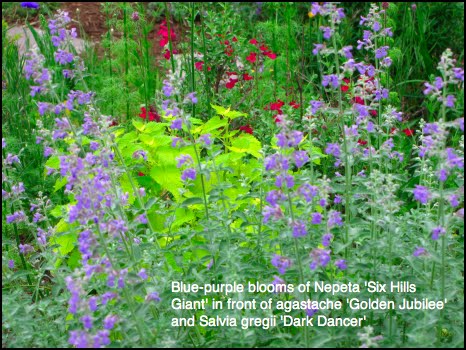
 Catmint (nepeta) may have been the first perennial that I found to be totally deer and rabbit resistant. Even better, nepeta x faassenii 'Six Hills Giant' is a great companion to almost all of the plants, shrubs and trees in my sunny garden.
 Favorite Companions for Nepeta include:
Agastache ('Golden Jubilee' foliage)
Allium ('Purple Sensation')
Dianthus
Dutch irises
Ice plant
Roses (Knock Out® 'Radrazz')
Salvia greggii ('Dark Dancer', 'Autumn Sage')
Salvia ('Caradonna', 'May Night')
Yarrow ('Moonshine', 'Coronado Gold')
Verbena (verbena bonariensis, 'Homestead Purple')
Gardeners in zones 3-8 can grow catmint in full sun to part shade. Give both 'Six Hills Giant' and 'Walkers Low' at least three feet of width and allow for three feet in height when in bloom. There are many other varieties of nepeta for those who want to explore other sizes and colors.
 Is there a downside to growing nepeta?
 I don't have a cat to know if they love to roll on it. I may have too much of a good thing when it's time to trim the nepeta as it takes me several days. I trim it after the first bloom in order to get more flowers. When the season ends, I cut it back either in fall or wait until spring. The foliage mounds are much neater over the winter if cut back in the fall.
Outside of making the rounds to trim it—the nepeta can be ignored until time to divide it. 'Six Hills Giant' matures quickly and I divide the clumps (by shovel) every two years in the spring. 'Walkers Low' is slower to mature and I haven't divided the original clumps in three years.
As I am able to divide the 'Walkers Low', I will complete an edging along a garden path. I'm using creeping thyme as a placeholder until I finish the edge with nepeta.
 With airy blue-purple blooms and lacy foliage, catmint is a also great filler for bouquets. I prefer to use 'Six Hills Giant' for bouquets since I can cut very long stems.
 Although I can't really prove it, I am convinced that nepeta helps to repel gnats, houseflies and mosquitoes since we don't have any of those insects here, but can walk down the road and experience the bites. Good insects, such as bees and butterflies, love the nectar of the nepeta.
Nepeta is a versatile perennial as an accent, companion or edger. If you have the space, I highly recommend adding nepeta to your garden.
| Words and photos by Freda Cameron, Defining Your Home, Garden and Travel. All company or product or patented names mentioned are registered trademarks/copyrights/patents owned by those respective companies or persons. |
Build a Bouquet of Flowers
 There are now enough perennials in my garden that I've overcome my reluctance to cut the blooms to use indoors. Creating a colorful bouquet brings a sense of satisfaction. Doing so is even more fun when giving the bouquet to someone else. I carried this bouquet to a dear neighbor who hosted a neighborhood gathering.
All flowers used in my bouquet are perennials from my zone 7, full sun, deer resistant garden. None of these plants are protected with deer fences or repellents. However, the rabbits will occasionally nibble Dutch iris foliage or the chives.
False Indigo (Baptisia australis)
Dutch Iris (iris x hollandica)
Catmint (Nepeta 'Six Hills Giant')
Flowering Onion (Allium aflatunenense 'Purple Sensation')
Culinary Chives (Allium schoenoprasum)
Stick Verbena (verbena bonariensis)
Yarrow (probably achillea 'Moonshine')
Yellow Flag Iris (iris pseudocorus)
When cutting the bouquet, I carried the vase out to the garden with a few inches of water to keep the stems as fresh as possible. I clean my pruners to make sure there is no soil or bacteria on the blades. By creating this arrangement as I went around the garden, it was easy to cut as many flowers as I needed for a full bouquet.
I didn't grow these flowers with the idea of a bouquet—the bi-color Dutch irises provided the key to the color scheme and everything else just fell into place.

(Note: The Dutch irises are not as blue as shown in the photo. They are deep violet which two different cameras and several settings could not accurately reflect without washing out the other flower colors.)
| Words and photos by Freda Cameron, Defining Your Home, Garden and Travel. |
Subscribe to:
Posts (Atom)
Popular Posts
-
 By Freda Cameron Although the weather has passed for planting, this is a great time to plan a garden with the children in your family. Durin...
 -
 George Washington's Mount Vernon is a reminder of the self-sufficiency of farms of historical significance. Did you know that Washingto...
 -
 Coreopsis ' Star Cluster ' in bloom with companions Eucomis 'Sparkling Burgundy' ( foliage left) echinacea (multiple...
 -
 The image of a table laden with a bountiful harvest isn't just for Thanksgiving. Local farmers' markets and Community Supported Agri...
 -
 I tried to make a garden plan when I spread the soil in fall 2006 to create the outer gardens. I researched and researched the right plant...
 -
 There are few plants in the garden that are virtually maintenance-free. My favorite foliage plant is carex hachijoensis 'Evergold' ...
 -
 Katie and the Giant Cabbage The idea for Katie’s Krops began with a 9 year old girl and a 40 pound cabbage. In 2008 Katie brought home a ti...
 -
 These "green" disfigured coneflowers were removed and destroyed. I didn't plant any new " green bloom " echinace...
 -
 May I see your identification please? Theft comes in many forms and recently garden bloggers have discovered that there are bad guys who wi...
 -
 By Freda Cameron What is the process of working with a professional garden designer? I asked this question at a local garden center that ha...